Data cleaning minimizes issues that make datasets unsuitable for analysis or modeling, following exploration and validation in a typical data science workflow. section 1.2.7
Common cleaning tasks include:
- Replace missing values. section 1.2.7
- Remove highly correlated variables. section 1.2.7
- Treat highly skewed variables, potentially by transforming features. section 1.2.7
- Address imbalanced datasets. section 1.2.7
Ad-click prediction
A dataset for predicting ad clicks may be imbalanced because most users never click an ad, making imbalance an explicit cleaning concern. section 1.2.7
Cleaning can occur during preprocessing before model training; at larger scales, processing and transformations may also require attention to memory and efficiency. section 1.2.3 section 1.4.2
Figure 1.4 A sample data science workflow. Data science workflows involve key steps like gathering data, exploring and cleaning the data, feature engineering, and model development. The model evaluation piece is also a highly important step, that we will cover in detail when we discuss model monitoring later in this book.
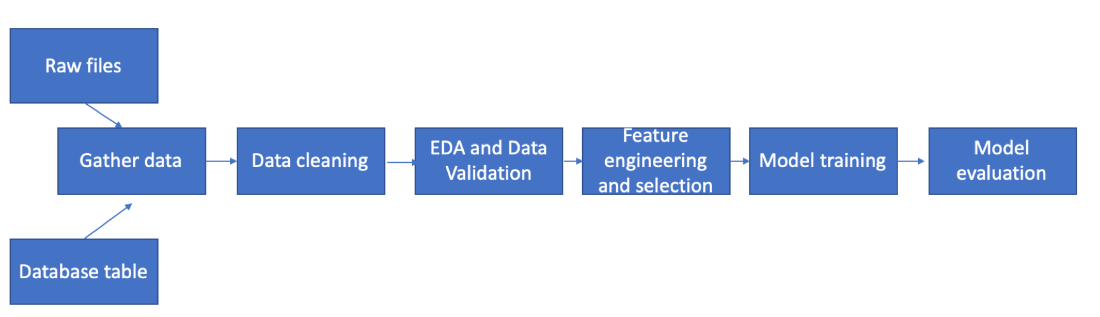
Use the workflow figure to place cleaning alongside data gathering, exploration, feature engineering, model development, and evaluation. section 1.2.7

















