liveBook · Manning

Decision tree

As explained in Data-Driven Cybersecurity

A predictive model that recursively partitions data through feature-based decision rules arranged in a tree structure.

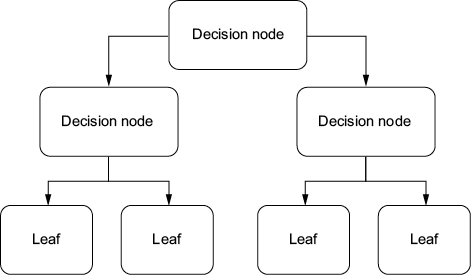
A decision tree classifies data through a sequence of feature-based questions. Decision nodes split the analysis, branches represent possible paths, and leaf nodes provide the resulting classification. The path from root to leaf turns a complex decision into simpler, sequential choices. section 12.3.1

Threat detection

For incoming network traffic, a tree can ask whether an email sender is trusted, whether traffic volume is unusual, or whether login attempts are suspicious. A final leaf can classify the activity as safe or a potential threat. Random forest extends this idea by combining multiple decision trees when classifying benign and malicious traffic. section 12.3.1

Figure 12.3 Elements of a decision tree
A diagram of a decision tree

Description automatically generated

Use the figure to identify the root, decision nodes, branches, and leaf outcomes in a tree structure. section 12.3.1


How Data-Driven Cybersecurity covers it

How deep it goes
Explains nodes, branches, leaves, and root-to-leaf paths, but stops short of detailed training internals.
Examples
Illustrates trusted senders, login attempts, network traffic, phishing detection, and safe-versus-threat leaf outcomes.
What it assumes
Assumes basic machine-learning context while supporting implementation with Python, Jupyter Notebook, and scikit-learn.
What you can do after
Evaluate decision-tree-based classification within practical cybersecurity threat-detection workflows.
How it connects
Connects decision trees with supervised learning, random forests, SVM, classification, and cybersecurity.

Also explained in

Compare how 13 books explain decision tree →

Related concepts

This explainer was generated by Manning's knowledge graph from the text of Data-Driven Cybersecurity. The section links point to the parts of the book it draws on.










