liveBook · Manning

Decision tree

As explained in Data Without Labels

A tree-structured predictive model that recursively splits data into nodes using decision rules.

A decision tree is presented as one algorithm for regression problems, alongside linear regression, random forest, k-nearest neighbor, boosting, and neural networks. section 1.5.1

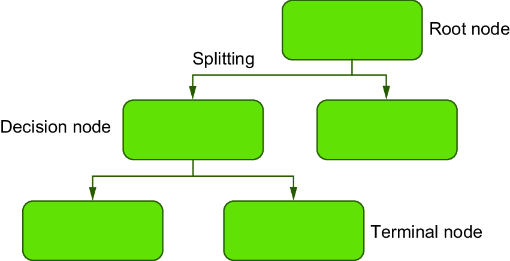
Its structure begins with a root node; splitting produces decision nodes and terminal nodes, with terminal nodes marking points that cannot be split further. section 1.5.1

Figure 1.13 A decision tree has a root node, and after splitting, we get a decision node and a terminal node, which is the final node and cannot be split further.
figure

Inspect the diagram of a root node splitting into a decision node and a terminal node. section 1.5.1


How Data Without Labels covers it

How deep it goes
Defines roots, decision nodes, and terminal nodes, but does not explain split criteria, training, or prediction procedures.
Examples
Places decision trees beside a height-to-weight regression problem and a structured telecom churn dataset.
What it assumes
Assumes basic supervised-learning concepts such as independent variables, target variables, labels, and regression.
What you can do after
Evaluate/understand a decision tree’s basic node-and-split structure and recognize it as a regression option.
How it connects
Connects decision trees with supervised learning, regression, random forests, k-nearest neighbors, boosting, and neural networks.

Also explained in

Compare how 13 books explain decision tree →

Related concepts

This explainer was generated by Manning's knowledge graph from the text of Data Without Labels. The section links point to the parts of the book it draws on.










