Deep learning uses neural networks with multiple learned layers to solve AI and machine-learning tasks. Its practical challenge is not only training a network, but also developing, tuning, and optimizing a system that needs substantial data and computational resources. section 1.0 section 1.6
A usable model is rarely taken directly out of the box. Improvement can require choosing an architecture and adjusting options such as learning rate, activation function, training-data amount, batch size, epochs, and middle-layer size. These choices interact: larger models may fit better but take longer to train, while data and batch-size changes must be balanced. section 1.3 section 5.1.1
Evolutionary deep learning treats optimization as a broader automation problem across the development workflow:
- Use evolutionary computation to alter or create combined evolutionary computation/deep-learning models. section 1.5
- Apply approaches including neuroevolution, evolutionary hyperparameter optimization, and neuroevolution of augmenting topologies. section 1.6
- Contrast customizable evolutionary strategies with AutoML services, which can automate workflows but may limit agile customization. section 1.6
Tune a function-approximating network
Run a PyTorch notebook that approximates a function, then change middle-layer size, batch_size, and data_step. Compare predicted fit and training time; changing the middle layer to 25 or larger produces a better-fitting second test in the demonstrated run. section 5.1 section 5.1.1
Classify handwritten digits
Load and normalize MNIST images, train a network, inspect loss, accuracy, and a classification report, then run genetic-algorithm evolution and compare its accuracy progression with the trained model. section 6.5
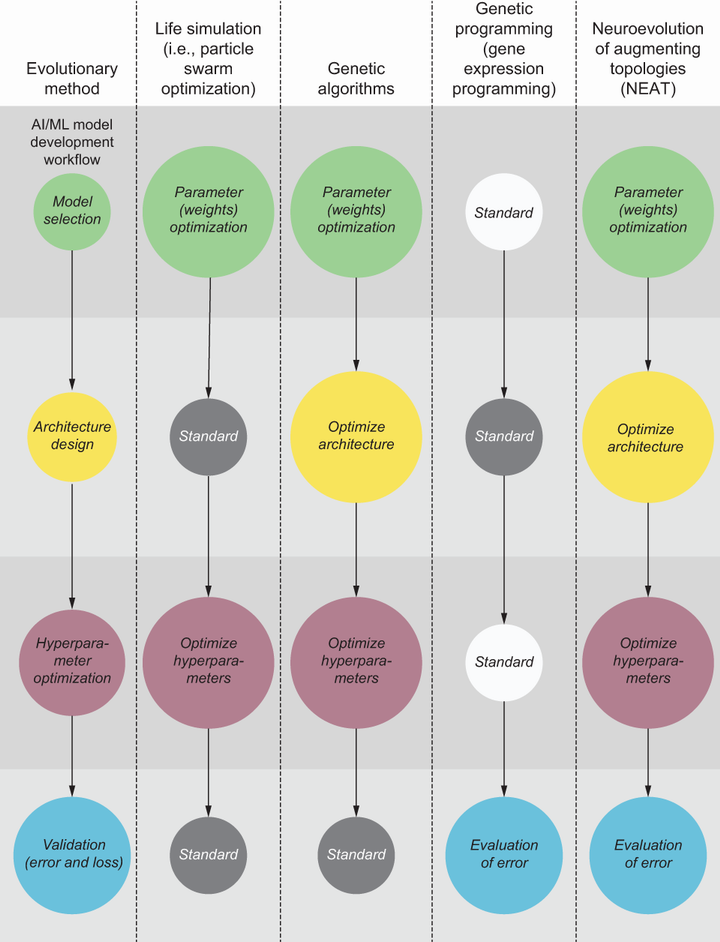
Maps where evolutionary-computation methods can be applied to deep-learning development across the AI/ML workflow. section 1.5










