Deep learning uses multi-layer neural-network architectures to learn hierarchical representations, especially when inputs are complex and unstructured, such as images, sound, or natural language. section 7.3.3 section 7.3.4
Treat deep learning as a model-selection decision with explicit delivery checks:
- Benchmark a familiar algorithm before adopting a novel deep architecture; retain the simpler option when it meets the required output. section 7.3.3
- Match the architecture’s inductive bias to the data: convolutional networks capture image localities, while recurrent, graph, and attention-based networks target other structures. section 7.3.4
- Check transparency, training expense, inference latency, production cost, and environmental impact before treating functional performance as sufficient. section 7.3.3
Why architecture matters for images
A basic perceptron receives image pixels in sequence and loses their spatial relationships, making object recognition difficult. A convolutional network instead propagates information locally with learned sliding-window filters. section 7.3.4
Figure 7.6 Inductive bias in ML algorithms (adapted from Jumper, Evans, et. al. [6]. The sequence (a) through (e) is determined by the order in which these biases gained popularity in the ML community. The arrows indicate the propagation of signal across a network or in a graph.
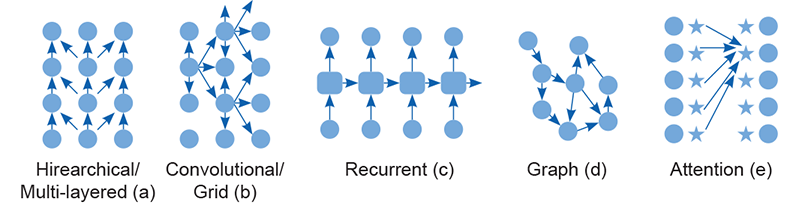
Compare the inductive biases of multi-layer perceptrons, grid-based vision networks, recurrent networks, graph networks, and attention-based transformers. section 7.3.4










