Deep learning uses neural networks to map inputs to predictions through learned nonlinear transformations. Unlike classical machine learning, it can learn transformations end to end rather than relying entirely on manually engineered features. section 1.3 section 1.4
It is especially successful with images, audio, video, and text, but tabular business data presents a less settled choice. Gradient boosting is often the practical baseline because it can be simpler, more transparent, and strong on typical heterogeneous tables. section 1.4 section 1.6 section 5.2.3
Use deep learning for tabular prediction as a deliberate workflow:
- Compare it with a classical baseline such as XGBoost using simplicity, transparency, and efficacy—not accuracy alone. section 3.0 section 3.5
- Clean and reshape columns before training: handle missing values, convert numeric strings, and split mixed-purpose fields into usable features. section 9.6
- Define preprocessing and model components with Keras layers, keeping hyperparameters in configuration where practical. section 9.3 section 9.4
- Train with validation and callbacks such as early stopping, then evaluate on a test dataset and exercise the trained model on realistic cases. section 9.4 section 9.6
Classifying Kuala Lumpur property prices
A property dataset combines location, price, rooms, bathrooms, parking, property type, size, and furnishing. After cleaning its mixed and missing values, a Keras model predicts whether a listing price is above or below the market median; callbacks stop training when validation performance no longer improves. section 9.0 section 9.1 section 9.4
Deep learning can need substantial data to generalize well. With smaller tabular datasets, many columns, and higher overfitting risk, classical approaches may perform better; combining deep learning and gradient boosting can sometimes improve predictions because their errors differ. section 12.1 section 12.6
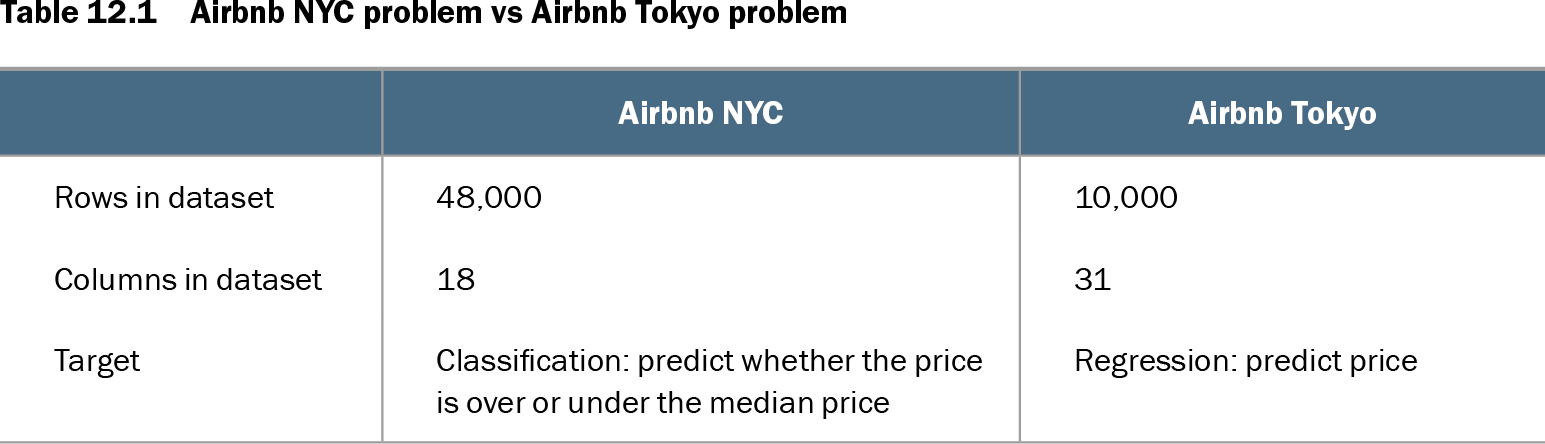
Table 12.1 Airbnb NYC problem vs Airbnb Tokyo problem (view table figure)
| Airbnb NYC |
Airbnb Tokyo |
|
|---|---|---|
| Rows in dataset |
48,000 |
10,000 |
| Columns in dataset |
18 |
31 |
| Target |
Classification: predict whether the price is over or under the median price |
Regression: predict price |
Compare the NYC classification and Tokyo regression datasets to see how row count, column count, and target type change the difficulty of applying deep learning. section 12.1