Deep learning uses neural networks with more than a few layers. Each layer calculates numeric values from its inputs and passes them to the next; the final layer produces a prediction. For an image, inputs can be pixel values; for a table, they can be feature values. In outlier detection, deep networks provide several ways to judge whether an object is unusual. section 16.1 section 16.0
Figure 16.1 Example of a neural network. The square points at the left are the input. The circular points are neurons. During prediction, as input is given to the neural network and neurons calculate their values (floating point numbers each neuron will contain) one layer at a time (left to right) based on the input, with the final (rightmost) layer containing the prediction for the input.
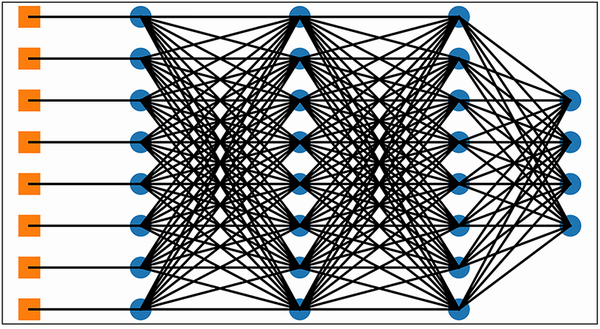
Follow the input from left to right: neurons calculate values one layer at a time, and the rightmost layer holds the prediction. section 16.1
For images, deep-learning approaches include:
- Reconstruct the image after compressing it, then use reconstruction error to estimate how unusual it is. section 16.3.1
- Use a generative model to assess unusual data, including approaches that attempt to regenerate it. section 16.3.1
- Inspect a classifier’s confidence: low probabilities across its known classes can suggest an out-of-distribution image. section 16.3.1
- Create embeddings and apply detectors such as Isolation Forest or k-nearest neighbors; embeddings made for classification or regression may not work well for this purpose. section 16.3.1
- Alter an image, perhaps by rotating it, and test whether a model identifies the alteration confidently; unusual images may yield more errors or lower confidence. section 16.3.1
Deep learning is particularly useful for image, video, and audio outlier detection, but it is typically less useful for tabular data than established alternatives. Deep networks can require substantial training data, run more slowly, and be harder to tune. Choose an approach according to the data and the signal it provides, rather than treating any one score as a universal test. section 16.0 section 16.3.1










