Deep learning helps computers find patterns in large, complex datasets. It is used for tasks such as recognizing images, processing speech and assessing fraud risk. Its results can be impressive, but success at a task should not be mistaken for human-like understanding. section 3.4.1 section 3.8
A deep neural network is a neural network with multiple hidden layers between its input and output. These layers can build representations of complex features from simpler patterns. During training, the network adjusts numerical weights to reduce errors; adding layers does not, by itself, make it more intelligent. section 3.4 section 3.8
Figure 3.4 A deep neural network architecture
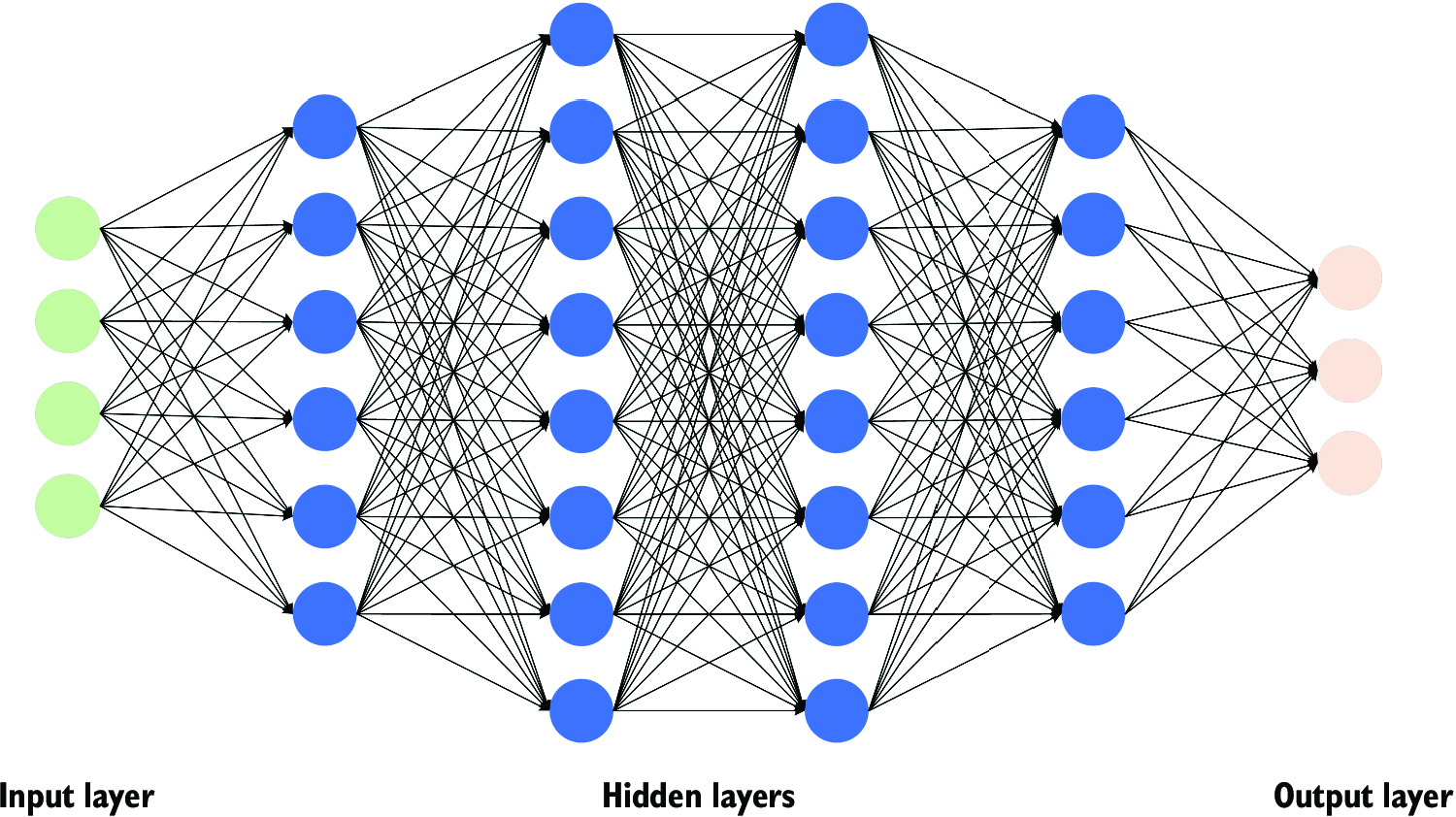
The architecture diagram shows the layers that give a deep neural network its name. section 3.4
Recognizing a cat
An image-recognition network can learn to classify pictures as “cat” or “not cat” from many labeled examples showing different appearances and viewpoints. Unlike a child who can generalize from an early encounter, the network learns weights that support its predictions—not what a cat means or how one behaves. section 6.2
The practical choice depends on both the task and the available data:
- Consider deep learning for pattern-heavy tasks such as image recognition, language processing, diagnosis support and predictive analytics. section 3.4.1
- Check whether enough suitable labeled data is available. Training can take time, performance may suffer on data unlike the training set, and changing objectives can require expensive retraining. section 3.4.2
- Consider combining it with other methods when a problem also calls for historical cases, handling uncertainty or explainable rules, as in a proposed fraud-prevention system. section 11.7










