Fine-tuning adapts a pretrained large language model (LLM) to a domain or task by training it further on a smaller, targeted dataset. Each training sample supplies a prompt and an intended completion, allowing the model to learn a particular style of response. For data storytelling, this can make generated titles, annotations, and commentaries more consistent with an audience and scenario. section 7.4.1 section 7.6
Use fine-tuning when a general-purpose model needs domain-specific behavior or knowledge. A separate dataset can target the general public, professionals, executives, particular products or topics, or a specific output type. Greater dataset specificity is presented as a route to better results. When the goal is instead to summarize a long document using external information, retrieval augmented generation (RAG) is the alternative: it combines retrieval with generation rather than retraining the model. section 7.4 section 7.4.1
Figure 7.10 A criterion to establish whether to extend an LLM or not
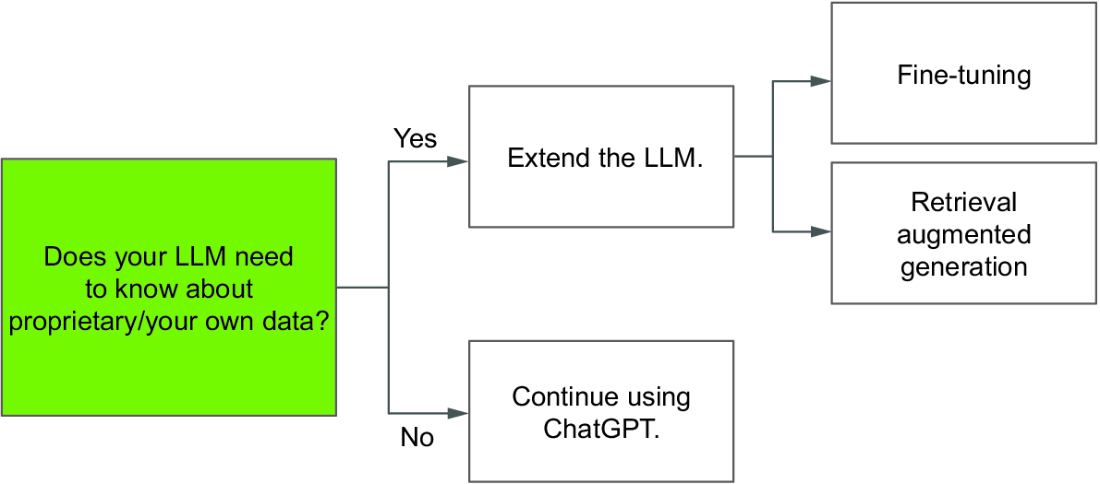
Use the decision criterion to decide whether an LLM must be extended with domain-specific information before generating a data-driven story. section 7.4
A practical fine-tuning workflow is:
- Define the desired behavior and assemble relevant prompt–completion pairs. Manual pairs offer direct control over the behavior expected for a given input. section 7.4.1
- Shape the examples for the intended audience and output. For example, prepare distinct data for public-facing, professional, or decision-maker commentary. section 7.4.1
- Convert the data to JSONL messages containing system, user, and assistant roles, then upload the file and create a fine-tuning job through the OpenAI API. section 7.4.1
- Wait for processing and job completion, retain the resulting model identifier, and use that identifier when requesting new generated text. section 7.4.1
Training commentary for a general audience
A training example frames the model as a data analyst communicating with the general public. Given household-chore percentages—cooking 35%, cleaning 30%, laundry 20%, and yard work 15%—the intended completion identifies cooking as the largest share and states the remaining values plainly. After fine-tuning, a request about rowing (62%) and cycling (58%) produces a concise commentary naming them as the most popular sports. section 7.4.1
Listing 7.1 The structure of a JSONL file
{
  "messages": [
     {
    "role": "system",
  "content": "You are a data analyst showing data to the general public."
     },
     {
         "role": "user",
         "content": "Distribution of household chores
                                  (Cooking 35% Cleaning 30% Laundry 20%, Yard work 15%)"
     },
     {
          "role": "assistant",
           "content": "Cooking takes up the largest portion at 35%.
                      Cleaning follows at 30% while laundry
                      and yard work accounts for 20% and 15% respectively."

     }
  ]
}
Inspect the JSONL message structure used to turn a system instruction, data prompt, and desired commentary into one training sample. section 7.4.1
Dataset preparation is the main effort. Fine-tuning is most useful when repeated outputs should follow a familiar structure for the same audience; it is not necessary when a general ChatGPT response is sufficient. Treat it as one way to add textual context that helps turn chart information into audience-appropriate knowledge. section 7.4.1 section 7.4 section 7.6




































