Fine-tuning adapts a pretrained model to a new task by continuing training on task-specific, well-labeled data. It turns a general detector into a production model for domain-specific objects. section 2.1.3
A practical fine-tuning workflow includes:
- Select a pretrained model whose existing capabilities provide a useful starting point. section 2.1.3
- Prepare separate training, testing, and validation images with labels for the target objects. section 2.1.3
- Evaluate the adapted model, then connect training and evaluation to repeatable retraining and model tracking. section 2.1.3
Identity-card detection
YOLO is trained on COCO classes that do not include identity cards or passports. Fine-tuning YOLOv8 on a well-labeled identity-card dataset produces a custom object detector for that domain. section 2.1.3
Figure 2.5 A view of a retraining pipeline using the modular codebase concept. This approach of keeping the model, code, configuration files, and data as distinct versioned components with lineage links ensures that the process remains flexible, fast, and adaptable while enabling experimentation, debugging, and iterative development.
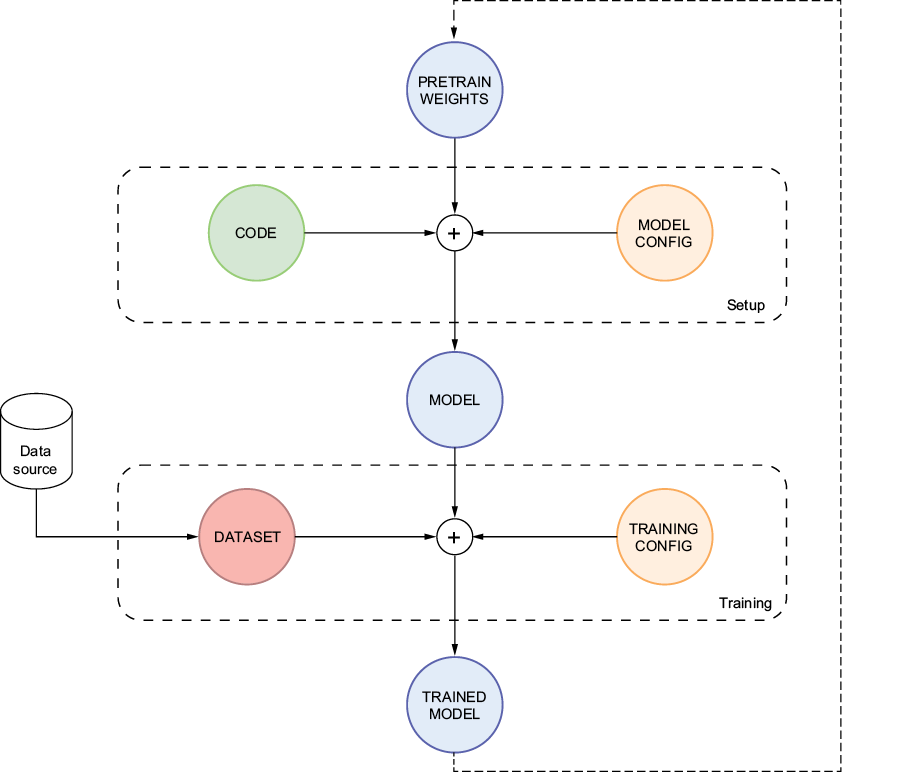
Use the retraining-pipeline view to connect fine-tuning with separately versioned models, code, configuration, and data, preserving lineage for experimentation and debugging. section 2.1.3




































