Fine-tuning adapts a pretrained, or foundational, model by training it further on targeted data. It can make responses more attuned to a domain, tone, detail level, or instruction pattern. section 10.2.2 section 12.1.1
A practical fine-tuning process includes:
- Set a specific goal for the tuned model before choosing data or tools. section 12.1
- Prepare relevant, well-formatted data; its size and quality strongly influence the result. section 12.2.1
- Preprocess the data through tokenization, run the tuning session, and monitor measures such as loss and learning rate. section 12.2.4 section 12.3
- Test the resulting model through automated inference or manual evaluation, then iterate on data, model, tooling, or hyperparameters. section 12.2.6 section 12.3
Domain-specific code assistant
A model can be tuned on the restful-booker-platform codebase so that questions about the project receive context-sensitive answers. Example training records pair instructions such as asking for a class declaration or a setup method with the expected code output. section 12.2 section 12.2.1
Figure 12.1 A visual representation of the different steps taken during fine-tuning
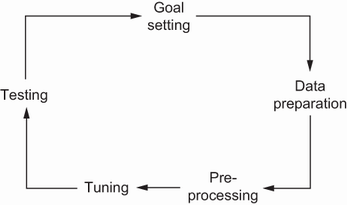
Use the process map to navigate goal setting, data preparation, processing, tuning, and testing as connected stages. section 12.1.1
Fine-tuning offers more model and framework control than RAG, but requires a steeper learning curve, more experimentation, and potentially substantial hardware, tooling, and talent costs. Combining both approaches increases complexity and debugging difficulty. section 10.2.3 section 10.2.4




































