Fine-tuning adapts a pretrained language model to a domain or task by continuing training with targeted examples and expected outputs. It becomes useful when prompt engineering cannot provide sufficiently accurate or stable results. section 5.3.1
A practical fine-tuning workflow includes:
- Explore the domain and identify ambiguities, such as inconsistent references to the same person. section 5.3.1
- Engineer prompts first, then reuse them to preannotate a small dataset before completing human annotations. section 5.3.1
- Train task-specific components when larger schemas or complex extraction tasks exceed the scalability or reliability of in-context learning. section 15.4.3
- Budget for annotation, infrastructure, prediction, and model-version management costs. section 5.3.4
Figure 5.4 The two roles of LLMs in KG generation from textual data: the prompt-based approach (upper branch) and the fine-tuning approach (lower branch)
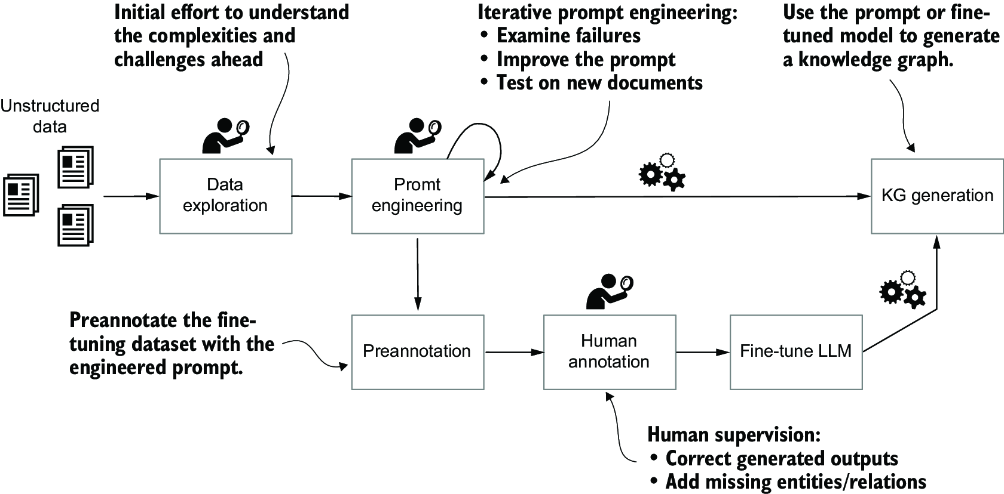
Compare prompt-based inference with the fine-tuning branch for generating knowledge graphs from textual data. section 5.3.1




































