Fine-tuning is a second training stage that adapts a pretrained language model to a particular task, domain, or behavior. It continues training from a base model with a smaller, specialized dataset, changing the parameters that guide its outputs. Pretraining supplies broad knowledge; fine-tuning makes that knowledge more useful for instruction following or a specific application. section 5.0 section 5.1
Fine-tuning is usually applied through two related approaches:
- Supervised fine-tuning (SFT) repeats the ordinary training process on high-quality, task-relevant examples, such as internal manuals, medical records, legal transcripts, or code. section 5.2.1
- Reinforcement learning from human feedback (RLHF) uses quality objectives and feedback to encourage harder-to-specify behavior, such as being a useful chatbot. section 5.2 section 5.3.3
- SFT and RLHF can be combined in sequence, and repeated rounds can specialize a general language model for code or mathematics. section 5.2.3 section 6.2
The practical trade-off is straightforward: fine-tuning can be more effective than endlessly refining prompts, but it requires suitable data, collection effort, and hardware. It is not a guarantee of reliable behavior. A model can reproduce sensitive training information, and RLHF can optimize a reward while producing undesirable or strange results. Do not fine-tune on information that must remain private. section 5.2 section 5.2.1 section 5.3.3
A car-sales assistant
A general model may know about cars but not a company’s products, sales scripts, or internal manuals. Fine-tuning on manuals, chat histories, emails, marketing material, and carefully written examples can adapt the model to that company’s sales task. The resulting model may still need prompting, output checks, and monitoring. section 5.1 section 5.2.1 section 5.4
Figure 5.3 Supervised fine-tuning (SFT) is a simple approach to improving model results. You repeat the same process used to build the base model. Once the base model is trained on a large amount of general data, you continue training on the smaller specialized data collection.
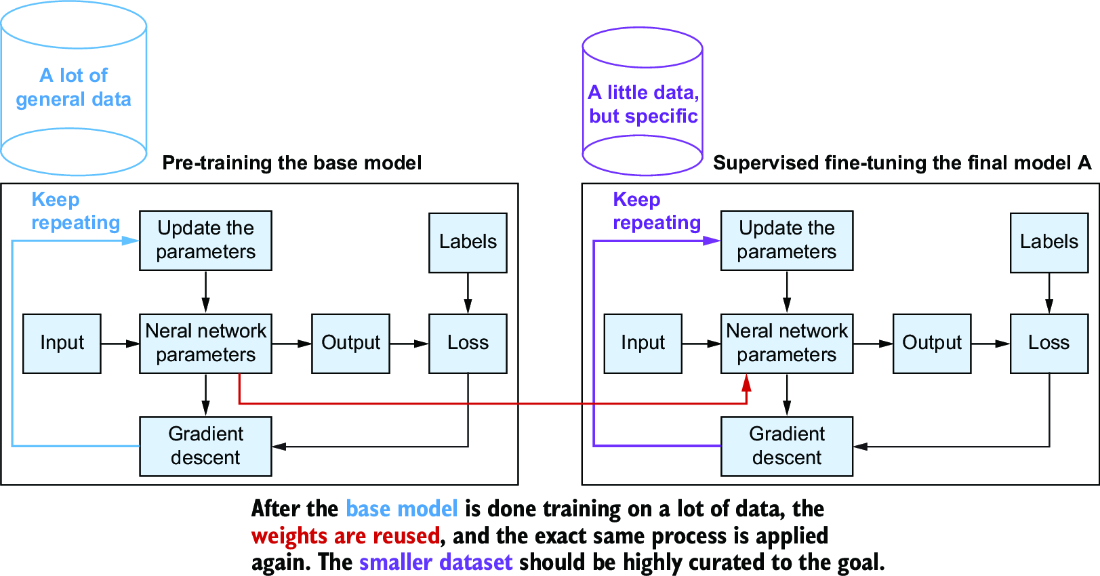
Shows the central workflow: continue training a broadly trained base model on a smaller specialized collection. section 5.2.1




































