A GPT model is a decoder-only transformer language model that generates text by predicting the next token from the preceding context. This design favors natural language generation and supports streaming, but syntax-driven output can produce hallucinations or miss intended meaning. section 2.3.2
Figure 2.6 A decoder visualized. Decoders are the second half of a full transformer, and they excel at NLG tasks like chatbots and storytelling. Decoders improve upon previous architectures in the same way as encoders, but they shift their output one space to the right for next-word generation to help utilize the advantages of multihead self-attention.
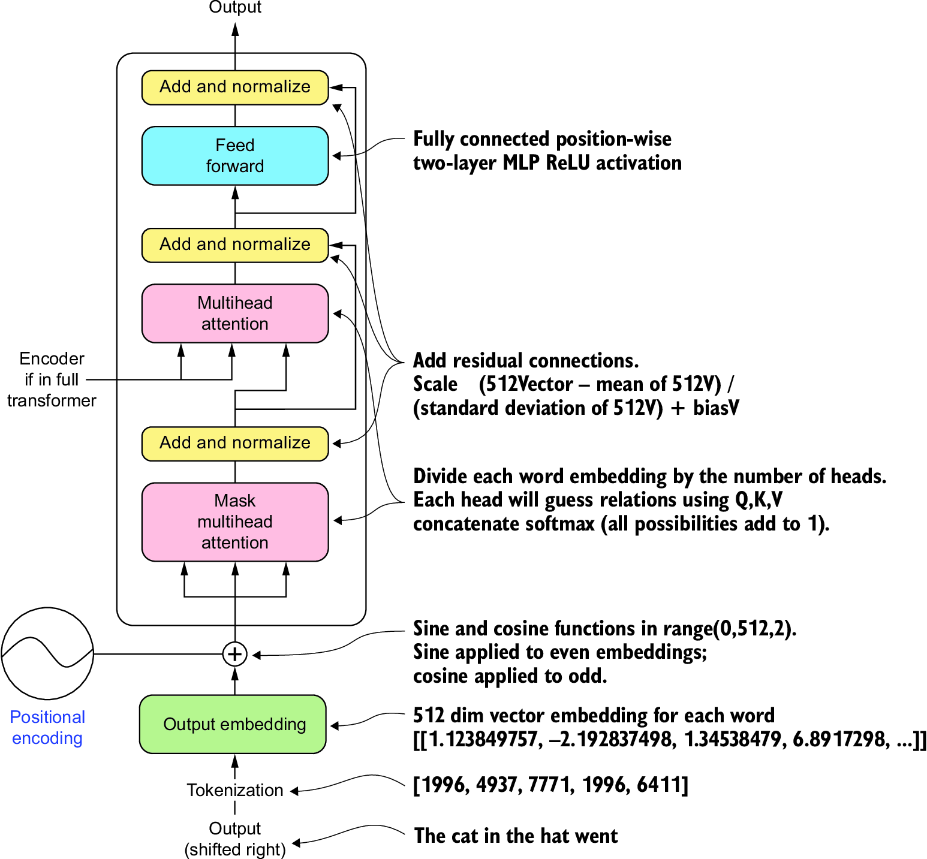
Use the decoder diagram to trace shifted-right outputs, multihead self-attention, and the architecture’s focus on next-token generation. section 2.3.2
The GPT family grew from GPT-1’s 120 million parameters in 2018 to GPT-2’s 1.5 billion in 2019 and GPT-3’s 175 billion in 2020. ChatGPT is described as a conversationally fine-tuned GPT-3 model using reinforcement learning with human feedback, while later systems expose fewer architectural and training details. section 4.1.1
Tokenization can outweigh model size
A comparison shows GOAT 7B outperforming GPT-4 on several arithmetic prompts. The proposed explanation is tokenization: GPT-family tokenization groups subwords and digits by frequency, potentially hiding numerical structure that another tokenizer preserves. section 4.4.1
Practical implications:
- Treat GPT as a text-generation system rather than a guarantee of intended meaning or factual reliability. section 2.3.2
- Inspect tokenization for numerical or domain-specific tasks because it determines what the model receives during embedding and inference. section 4.4.1
- Distinguish the generic GPT architecture from OpenAI-branded products and from open-source variants such as GPT-J. section 4.1.1

















