A hallucination occurs when a language model generates coherent, plausible-sounding content that is factually unsupported, fabricated, or based on false reasoning. The risk increases when the requested subject is absent from the model’s training data, because the model still predicts a likely continuation rather than acknowledging its lack of knowledge. section 5.3 section 13.3
A reliability-oriented response treats hallucination as a grounding problem:
- Ground responses in structured, verified knowledge from a knowledge graph to provide a factual foundation. section 1.3
- Use an LLM to translate natural-language questions into precise graph queries and summarize retrieved results. section 1.3
- Keep the underlying knowledge current through updates, knowledge-graph prompting, or GraphRAG rather than relying only on model retraining. section 1.3
- Validate extracted entities, relationships, and properties before using LLM-generated knowledge in downstream systems. section 1.0
Unsupported cost estimate
When asked for the cost of NASA’s SLS rocket without relevant information in its training data, a model may select a random number and present it as fact. section 5.3
Figure 1.4 KGs building with and without LLMs and LLMs support for querying and retrieval
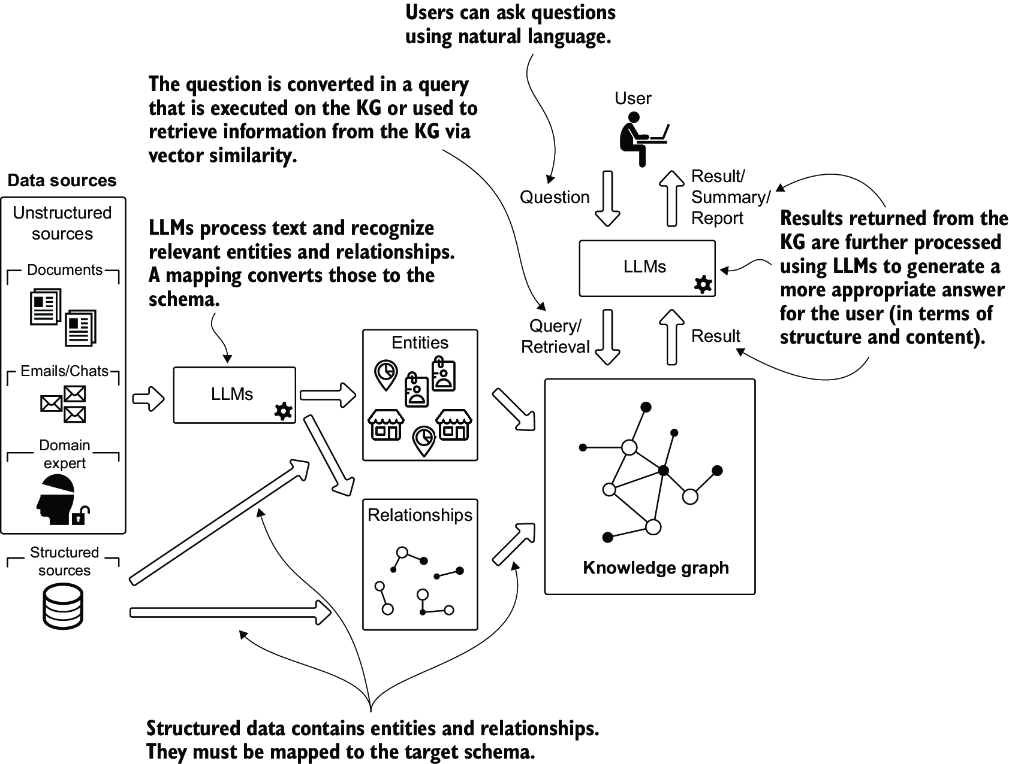
Use the architecture diagram to trace how knowledge graphs and LLMs support knowledge building, querying, and retrieval. section 1.3




























