A hypothesis is a proposed explanation or relationship that can be checked against evidence. It gives an investigation a useful starting point: choose a plausible claim, gather relevant data, model the relationship, and see whether the claim holds up on data the model has not seen before. A hypothesis is not a fact waiting for applause; it is an idea that can survive, change, or be abandoned. section 1.7 section 1.8
Figure 1.1 An example of the four steps in applying statistical analysis to data, studying whether temperature affects sports drink sales
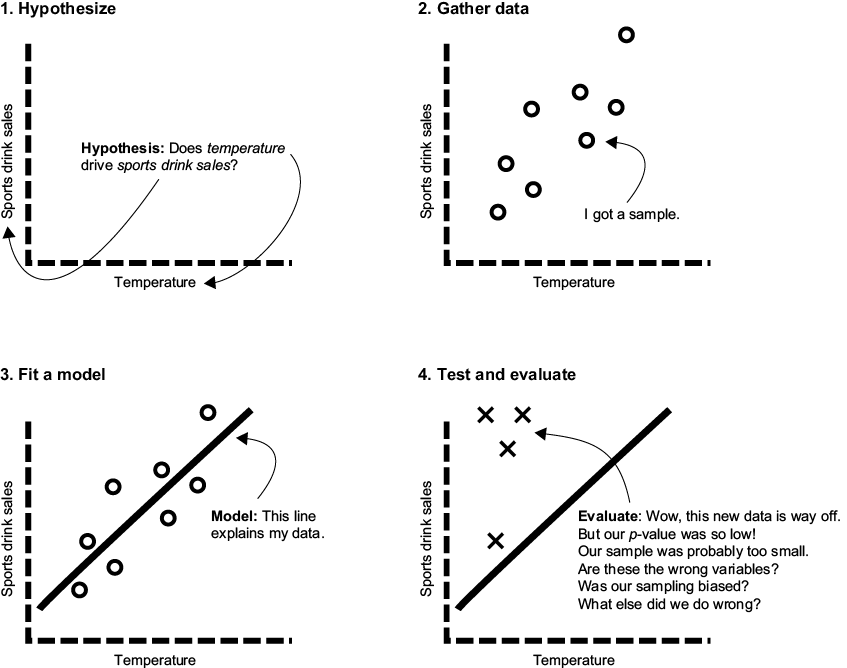
Use the four-stage flow to keep a claim connected to the variables, data, model, and evaluation needed to assess it. section 1.7
For example, suppose you think hotter weather increases sports drink sales. Temperature is a candidate input variable and sales is the outcome. After using common sense to narrow the many possible drivers, collect a representative sample, inspect its quality, fit a model such as linear regression, and test its errors on new data. A line that fits the original points but misses new ones does not support a relationship that generalizes well. section 1.7 section 7.13
A testable hypothesis benefits from a few practical habits:
- State the relationship or claim clearly enough that data could challenge it. section 6.0
- Choose variables for a reason, but remain willing to abandon a poor hypothesis rather than force the data to fit it. section 1.7 section 7.13
- Check performance on unseen data instead of treating a good fit to existing data as proof. section 1.7
- Avoid turning correlation, a p-value, or a model output into an automatic causal conclusion. section 7.13
In hypothesis testing, the claim often begins as a null hypothesis: a status-quo statement such as “a soda can contains about 305 mL.” The alternative hypothesis is the competing claim, such as “it does not contain about 305 mL.” Measure a sizable sample, compare its mean and variation with the advertised population claim, and ask whether the difference is unusually large rather than merely nonzero. section 6.0
A toddler-meltdown hypothesis
A parent might hypothesize that more hours without a nap raises the probability of a toddler meltdown. Record time since the last nap and whether a meltdown occurred across observations, then fit a classification model. The result applies to the observed child and conditions, not automatically to all children; the sampling frame and possible bias matter. section 8.2
The word also helps communicate uncertainty responsibly. When a business claim is doubtful or unverified, label it a current hypothesis rather than presenting it as fact. Pair that label with the conditions and evidence behind the claim, especially when incentives or marketing pressure could blur the distinction. section 10.18 section 10.27








