liveBook · Manning

Digital image

As explained in Deep Learning with R, Third Edition

An image is visual data represented as a structured arrangement of pixel values.

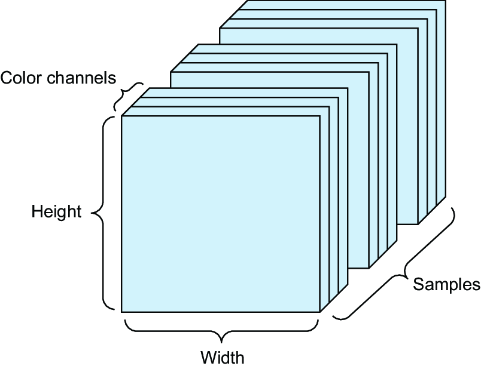
A digital image is visual data stored as a rank-4 tensor: samples, height, width, and channels. Each sample is a two-dimensional pixel grid, and each pixel contains a vector of channel values. section 2.2.8

Read the four dimensions as:

  • Samples: the collection of images being represented. section 2.2.8
  • Height and width: the dimensions of each image’s two-dimensional pixel grid. section 2.2.8
  • Channels: the vector of values associated with each pixel. section 2.2.8
Figure 2.3 A rank-4 image data tensor
figure

A figure shows how image data forms a rank-4 tensor. section 2.2.8

How Deep Learning with R, Third Edition covers it

How deep it goes
Defines the rank-4 shape and pixel-channel organization without explaining channel meanings or image-processing operations.
Examples
Uses a rank-4 image-data tensor diagram as its concrete representation.
What you can do after
Understand how image datasets map onto sample, height, width, and channel axes.
How it connects
Connects digital images to tensors, samples, pixels, channels, and video.

Also explained in

Compare how 16 books explain digital image →

Related concepts

This explainer was generated by Manning's knowledge graph from the text of Deep Learning with R, Third Edition. The section links point to the parts of the book it draws on.