Treat a digital image as spatial data whose values are organized for a neural network. Its two-dimensional structure carries meaning, so tensor organization should match that structure rather than flattening it indiscriminately. An image can be represented as I ∈ ℝ^{C,W,H}, where C is the number of channels and W and H describe spatial dimensions. section 3.0 section 3.4
Key implementation consequences:
- Represent a color image with multiple channels; a convolutional filter has a corresponding value for every input channel. section 3.4
- Use convolutions to detect local spatial patterns such as horizontal or vertical lines, color changes, and grid patterns. section 3.0
- Stack convolutional layers to combine simpler detected patterns into more complex ones for image classification. section 3.0
Figure 3.9 Example of a 1D convolution with two channels. Because there are two channels, the 1D input looks like a matrix and has two axes. The filter also has two axes, one for each channel. This filter slides from top to bottom and produces one output channel. One filter always produces one output channel, regardless of however many input channels there are.
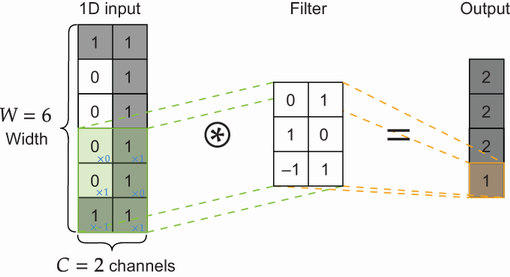
A two-channel convolution example shows how a filter spans every input channel and produces one output channel. section 3.4