A digital image represents visual content through numerical image values and associated information such as captions or surrounding text. Computers must convert both images and their labels into numerical representations before a model can use them. section 12.7 section 12.5
Image data is useful for training generative image models, but its quality and variety constrain what those models can create. Training only on paintings, landscapes, or another narrow category limits the resulting visual knowledge. section 12.5
Common sources of image data include:
- Web-crawled collections provide enormous scale and diversity, but often require extensive cleaning because images may have irrelevant captions, inconsistent resolutions, or varying aspect ratios. section 12.5
- Museum archives supply high-resolution art scans for learning artistic styles. section 12.5
- Scientific archives contribute specialized material such as biological diagrams, astronomical images, and medical scans. section 12.5
- Stock photography offers professionally produced images with detailed captions, supporting realism, object composition, and specific terminology. section 12.5
- Satellite imagery and synthetic 3D renders support geographic, environmental, spatial, and computer-generated visual knowledge. section 12.5
From a small image to numbers
A simple training set can contain 8×8 grayscale images of happy, sad, and neutral faces. Each tiny image becomes numerical data, while its facial-expression label also becomes a numerical representation. This makes the visual example and its meaning available to the model. section 12.7
Figure 12.10 Embedding in the diffusion model training life cycle
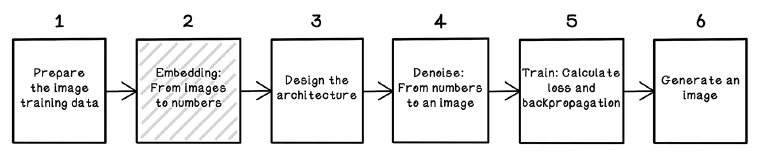
Trace how images and text labels enter the diffusion-model training process as numerical representations. section 12.7