Interpretability makes a model’s predictions understandable in the language of the modeled domain. Rather than exposing only architecture-level details such as nodes and activations, it connects outcomes to recognizable causes. section 1.3.3
A multilayer perceptron may expose ad-impression features and a purchase prediction while leaving its internal reasoning opaque. A causal model can instead represent engagement as an intermediate concept linking the impression to the purchase, producing a domain-level explanation. section 1.3.3
Decomposable causal models support interpretability by making their domain concepts useful for:
- Testing and validating model components independently. section 1.3.3
- Executing components separately and reusing them across related problems. section 1.3.3
- Explaining outcomes through causal relationships rather than opaque architectural activity. section 1.3.3
Explaining a purchase prediction
Represent the path as ad impression → engagement → purchase. The intermediate engagement variable gives the prediction a domain concept that can be inspected or further decomposed when the explanation requires more detail. section 1.3.3
Figure 1.1 A simple multilayer perceptron neural network that uses features associated with ad impressions to predict whether a purchase will result
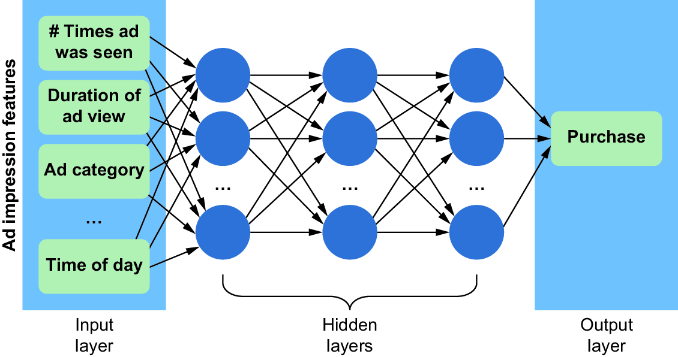
Compare a feature-to-purchase neural network with the decomposed causal pathway shown in Figure 1.2. section 1.3.3
Figure 1.2 A model that captures how ad impressions drive engagement, which in turn drives purchases. This model decomposes into {ad impression, engagement} and {engagement, purchase}.
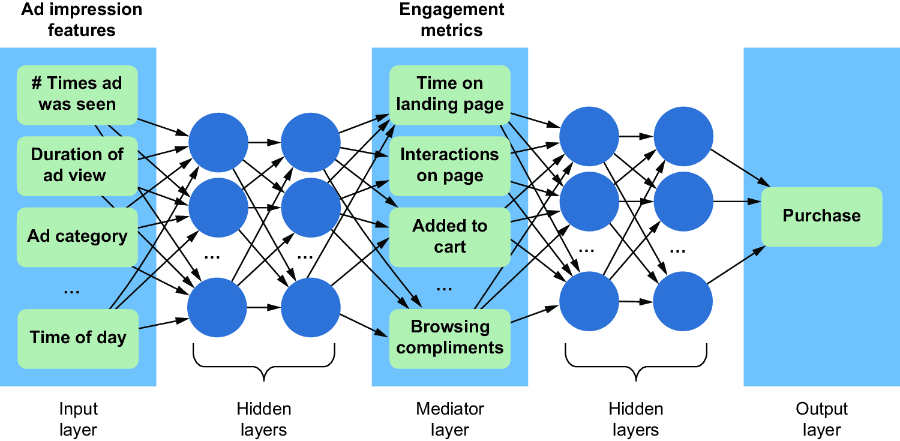
Inspect the decomposition into ad impression–engagement and engagement–purchase relationships. section 1.3.3















