Interpretability makes AI outputs inspectable by exposing the evidence, relationships, and reasoning behind them. Knowledge graphs support this by organizing extracted facts into verifiable structures rather than leaving answers inside an opaque model. section 6.4 section 1.3
A practical interpretability workflow can:
- Trace an answer through ontology relationships and information paths. section 7.4.2
- Expose supporting documents and structured facts for inspection. section 6.4
- Represent conflicting sources and validate or challenge apparent connections. section 6.4 section 7.4.2
Diabetes and pancreatic islets
A graph can show why type 1 diabetes and islets of Langerhans are connected, distinguish synonymous or ambiguous entity names, and let users follow the relevant ontology path into supporting documents. section 7.4.2
Figure 1.5 Summary of how LLMs and KGs can complement each other. Inspired by [11].
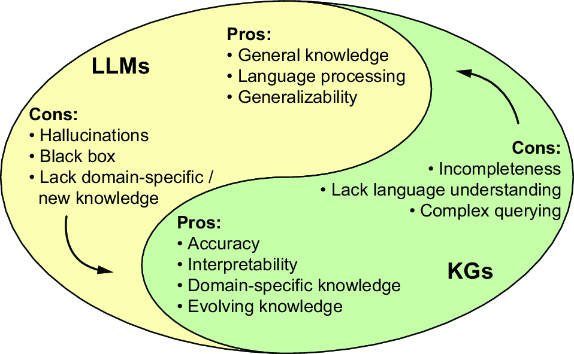
Use the complementarity diagram to inspect how language models add natural-language querying while knowledge graphs preserve traceable, structured reasoning. section 1.3















