liveBook · Manning

Kubernetes

As explained in Cloud Observability in Action

Kubernetes is an open-source system for orchestrating containerized workloads and managing their deployment, scaling, and operation.

Kubernetes orchestrates containerized workloads by managing resources such as namespaces, nodes, and workloads across a cluster. Its control plane manages resource state, while the data plane launches, health-checks, reports, and terminates containers running in pods. section 3.2.3 section 1.4

Kubernetes is useful for:

  • Running multi-service applications packaged as container images. section 1.4
  • Querying and changing the state of managed cluster resources. section 3.2.3
  • Exposing application and system signals, while leaving collection, routing, storage, and querying to an additional telemetry strategy. section 3.2.3

Deploying a microservices application

A local Sock Shop deployment clones the application repository, enters its Kubernetes deployment directory, creates a sock-shop namespace, applies complete-demo.yaml, and port-forwards the front-end service to localhost:8888. Traffic can then be generated through the browser while Kubernetes logs and metrics are inspected. section 1.4
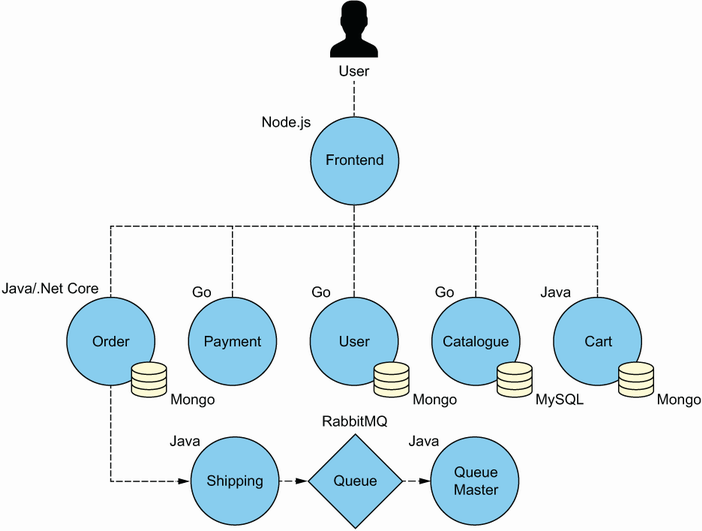
Figure 1.2 The example microservices app we use for observability exploration

Use the architecture diagram to relate Kubernetes control-plane and data-plane components to the deployed microservices. section 3.2.3


How Cloud Observability in Action covers it

How deep it goes
Explains control-plane and data-plane responsibilities, signal sources, and a local deployment workflow, but defers comprehensive telemetry processing.
Examples
Uses the Sock Shop microservices application, kubectl deployment commands, service port-forwarding, logs, and metrics.
What it assumes
Assumes access to a Kubernetes cluster and introduces resource management, workload execution, and observability responsibilities.
What you can do after
Operate a local Kubernetes deployment and inspect its application logs and metrics using kubectl.
How it connects
Connects container orchestration with workloads, pods, namespaces, control planes, data planes, logs, metrics, traces, and observability.

Also explained in

Compare how 22 books explain Kubernetes →

Related concepts

This explainer was generated by Manning's knowledge graph from the text of Cloud Observability in Action. The section links point to the parts of the book it draws on.



















