Kubernetes is an open-source container orchestrator: it automates deployment, scaling, and management of containerized applications across multiple machines. Unlike Podman, which primarily runs applications on a single node, Kubernetes coordinates clusters of containerized microservices. section 1.1 section 8.0
Kubernetes occupies a distinct role in the container stack:
- Orchestrates containers across multiple nodes and communicates with container engines. section 1.1
- Uses CRI-O or containerd as purpose-built container-engine backends; Docker is being discouraged as the Kubernetes backend. section 1.1 section 8.0
- Provides the coordination Podman lacks when applications require multiple instances, nodes, databases, and connected microservices. section 8.0
Running Podman inside a Kubernetes pod
CI/CD workloads can run Podman inside Kubernetes, but the pod must provide suitable privileges or Linux capabilities and more than one UID. Rootful execution uses a privileged container; rootless execution adds SETUID and SETGID and specifies runAsUser: 1000. section 8.4.2
Figure 1.1 Different open source projects dealing with containers within the categories of orchestrators, engines, and runtimes.
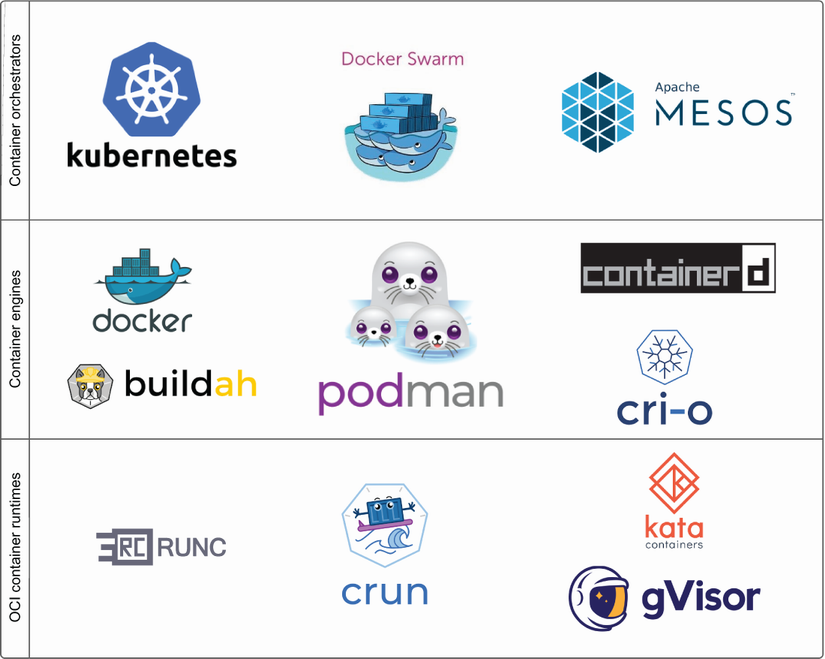
Use the container-stack diagram to distinguish Kubernetes as an orchestrator from container engines and OCI runtimes. section 1.1
apiVersion: v1
kind: Pod
metadata:
  name: podman-rootless
spec:
  containers:
  - name: rootless
    image: quay.io/podman/stable
    args:
      - podman
      - version
    securityContext:
      capabilities:
        add:
          - "SETUID"
          - "SETGID"
      runAsUser: 1000
Inspect the rootless pod specification to see how Kubernetes expresses Podman capabilities and an explicit numeric user ID. section 8.4.2