Kubernetes is a container orchestration platform for deploying and managing applications beyond a development machine. It helps recover failed containers, schedule workloads, and scale services across multiple nodes. section 3.3 section 3.3.1
A Kubernetes cluster separates control responsibilities from workload execution:
- The API server accepts commands from users, command-line interfaces, and other services. section 3.3.1
- The etcd key-value store records nodes, configurations, and system status as the cluster’s source of truth. section 3.3.1
- The scheduler matches containers with nodes based on required and available CPU and memory. section 3.3.1
- The controller watches workloads and launches replacement containers when applications go down. section 3.3.1
- Worker nodes run the container runtime and kubelet, which support application execution on the nodes. section 3.3.1
For ML platforms, Kubernetes provides the production foundation for resource-intensive and dynamic workloads. It supports deployment, scaling, and resource management so teams can operate training and inference workloads more effectively. section 3.0 section 3.3.7
Automated ML service deployment
A code change can trigger CI/CD to build a Docker image, push it to a container registry, create Kubernetes deployment manifests referencing that image, and apply the manifests to update the ML service. Kubernetes replicas can then support service scalability. section 1.3.3
Kubeflow notebook resources
When launching a notebook in Kubeflow, choose a Kubernetes namespace, image, memory and CPU requests or limits, and possibly GPUs or TPUs. Namespace settings can constrain quotas, mounts, and secrets; expensive accelerators require lifecycle rules that stop unused pods. section 7.1.1
Figure 3.4 Users interact with the API server in the master node to pass a command; the master node in turn communicates with the worker nodes to execute it. All of this is achieved by the components installed on the node.
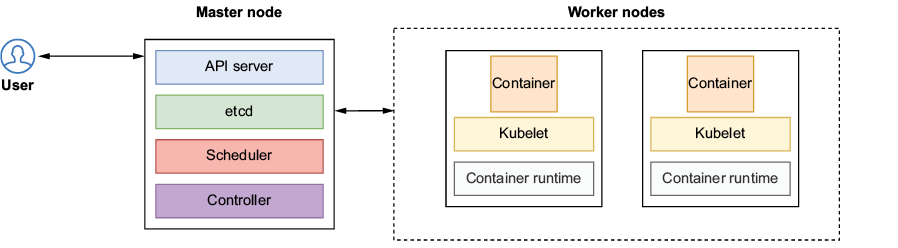
Use the architecture diagram to trace how users send commands through the API server and how the control plane communicates with worker nodes. section 3.3.1





















