Kubernetes is an orchestration engine and standardized API layer for running distributed application workloads. A cluster uses declared application health and desired state to coordinate services and continually correct failures. section 2.3.5 section 7.0
Its platform-engineering value is standardization: teams can use a common control plane for distributed-service compute orchestration and extensions without making every capability a vendor-specific implementation. section 2.3.5
Kubernetes supports platform capabilities by:
- Redeploying failing services, moving workloads from failing virtual machines, and scaling service instances with traffic. section 7.0
- Exposing orchestration logic through an API that platforms can extend beyond ordinary service management. section 2.3.5 section 7.0
- Providing a common execution environment for private CI runners, while allowing pipeline containers to start inside a local cluster. section 6.3.8
Private CI runners on a local cluster
A team can start Kubernetes locally with Kind, install kubectl, Helm, and the CircleCI CLI, then use CircleCI's container agent to run project pipelines in cluster-created containers. section 6.3.8
Figure 2.15 The components of a Kubernetes Cluster (Courtesy of https://kubernetes.io/docs/concepts/overview/components/)
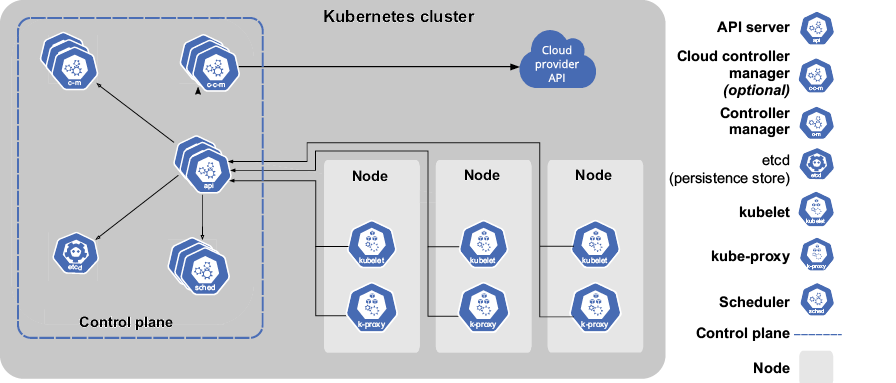
Use the cluster-components diagram to inspect the control-plane and workload pieces that make Kubernetes orchestration possible. section 2.3.5





















