In neural-network training, optimization turns information about error into updates to weights and biases, aiming to move future predictions closer to the desired outcome. More broadly, statistical optimization can shape model behavior under competing objectives without implying human-like intention. section 3.2.3 section 7.2.4
The update process involves several linked ideas:
- Gradient descent moves weights and biases opposite the gradient, which points toward increasing loss. section 3.2.3
- The learning rate controls step size. Large steps can overshoot; small ones can make progress impractically slow. section 3.2.3
- Momentum carries part of earlier movement forward, smoothing noisy gradient signals and supporting steadier progress. section 3.2.3
Finding a hidden object
The “hot and cold” analogy captures step-size tradeoffs: small moves may be slow, while large moves may overshoot the target. section 3.2.3
When models have tools, autonomy, and performance objectives, optimization can affect real-world decisions. Ethical constraints remain part of predictive calculations rather than categorical limits, so oversight and guardrails matter alongside alignment. section 7.2.4
Figure 3.8 The loss landscape can contain many dips and valleys. If the optimizer steps too cautiously, it may settle into a shallow solution with relatively high loss. If it steps too boldly, it may skip over configurations that yield lower loss or bounce back and forth across a good solution without settling. In practice, these landscapes exist in very high-dimensional spaces, where their geometry becomes more complex. Finding the right step size is key to guiding learning toward regions of lower loss.
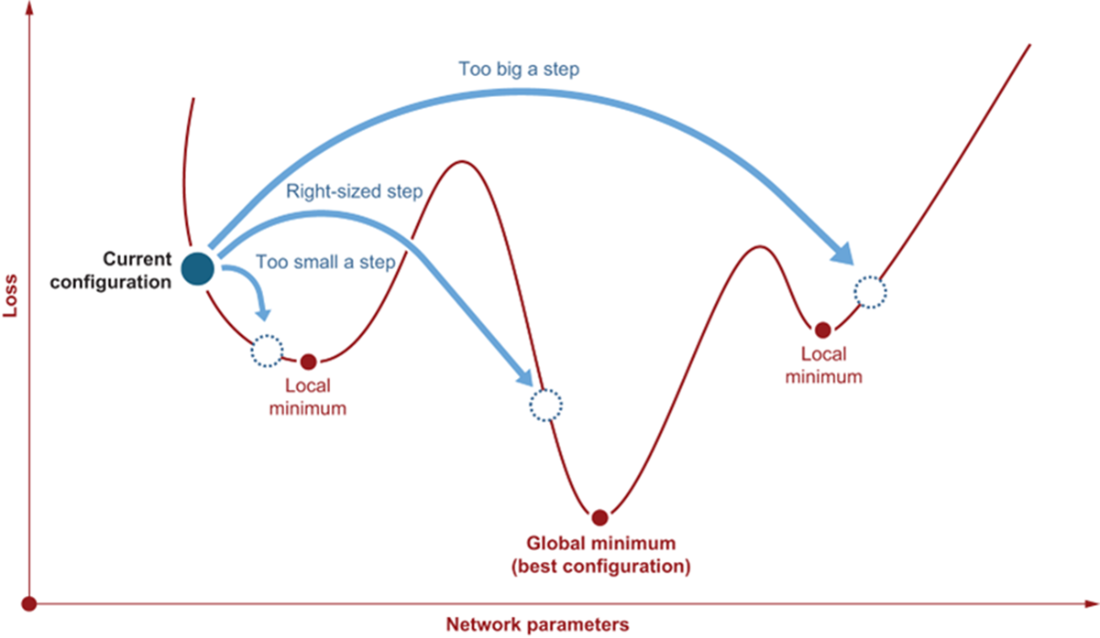
The loss-landscape figure illustrates how cautious or bold steps can lead to shallow solutions, missed low-loss configurations, or unstable bouncing. section 3.2.3





































