liveBook · Manning

Threshold

As explained in Data Without Labels

A threshold is a cutoff value that determines whether a neuron's combined input produces a firing or nonzero output.

In a perceptron, a threshold is the cutoff a weighted sum of inputs must exceed for the neuron to fire and produce a nonzero output. If the sum does not exceed the cutoff, the output is zero. section 8.2.2

Two-input perceptron

For inputs a and b with weights P and Q, the perceptron compares their weighted sum with threshold C. The output is zero when the sum is at or below C, and one when it exceeds C. section 8.2.2

Thresholds also filter association rules: a minimum support threshold, generally chosen with business stakeholders, selects rules meeting a desired support level. Thresholding can help reduce a large set of discovered rules. section 4.3.1 section 4.9

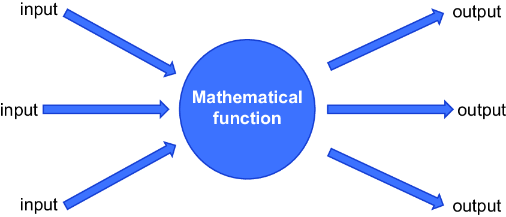
Figure 8.3 A neuron gets the inputs, processes them using mathematical functions, and then generates the output.
figure

A diagram of the neuron's inputs, processing, and output. section 8.2.2

How Data Without Labels covers it

How deep it goes
Defines the perceptron cutoff through weighted-input comparisons and identifies stakeholder choice for minimum support thresholds.
Examples
Uses a two-input perceptron with weights and cutoff C, plus transaction examples illustrating support thresholds.
What you can do after
Evaluate whether a perceptron's weighted input exceeds its firing cutoff.
How it connects
Connects perceptrons with weighted sums and activation functions, and association rules with support.

Also explained in

Compare how 13 books explain threshold →

Related concepts

This explainer was generated by Manning's knowledge graph from the text of Data Without Labels. The section links point to the parts of the book it draws on.











