liveBook · Manning

Reinforcement learning

As explained in Grokking Machine Learning, Second Edition

A machine-learning approach in which an agent learns to choose actions by interacting with an environment and receiving rewards or punishments.

Reinforcement learning teaches an agent to navigate an environment toward a goal without being given a dataset. Rewards and punishments guide its decisions as it learns from interaction. section 2.15 section 2.17

Grid world

A robot moves through a grid containing a treasure chest, a dangerous dragon, and an impassable mountain. After repeatedly exploring, it associates the dragon and nearby squares with low scores, and the treasure chest and nearby squares with high scores. It can then choose a safer path toward the treasure. section 2.16

Common applications include:

  • Games such as Go, chess, Breakout, and Super Mario. section 2.16
  • Robotics tasks such as picking up boxes, cleaning rooms, and dancing. section 2.16
  • Self-driving-car tasks such as path planning and behavior in particular environments. section 2.16
Figure 2.11 A grid world in which our agent is a robot. The goal of the robot is to find the treasure chest, while avoiding the dragon. The mountain represents a place through which the robot can’t pass.
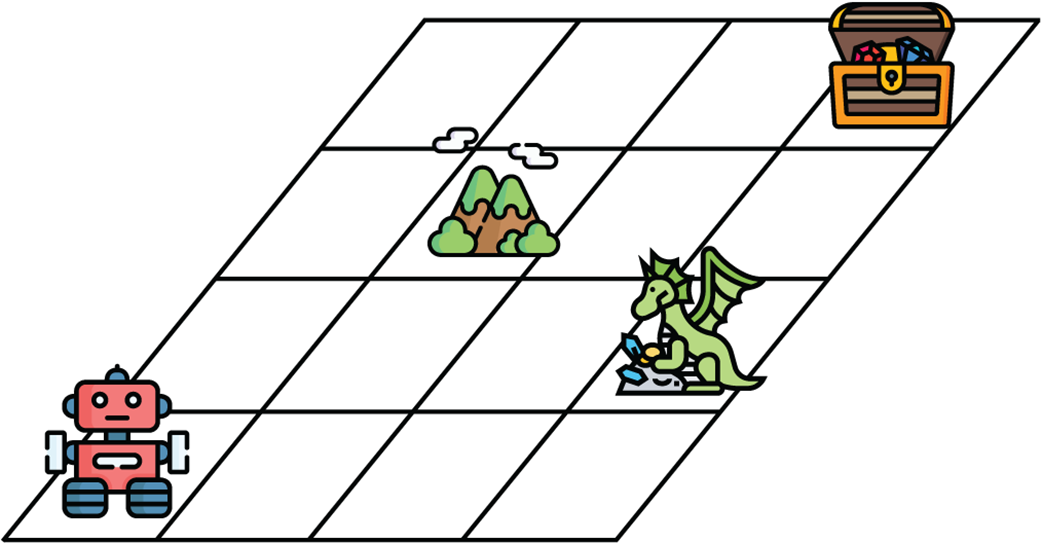
Use the grid-world diagram to see the agent, goal, hazard, and blocked route that structure the learning problem. section 2.16


How Grokking Machine Learning, Second Edition covers it

How deep it goes
Explains the agent, environment, goals, and feedback through a grid-world example, then defers deeper treatment.
Examples
Uses a robot grid world with a treasure chest, dragon, mountain, learned scores, and alternative paths.
What it assumes
Starts without supplied data and introduces learning through an agent, environment, goal, rewards, and punishments.
What you can do after
Understand how an agent can learn a goal-directed path from environmental feedback.
How it connects
Contrasts reinforcement learning with supervised learning and unsupervised learning, and connects it to robotics and self-driving cars.

Also explained in

Compare how 28 books explain reinforcement learning →

Related concepts

This explainer was generated by Manning's knowledge graph from the text of Grokking Machine Learning, Second Edition. The section links point to the parts of the book it draws on.