A database schema is a named namespace within a database that organizes objects such as tables, views, and functions. In a retail database, the schema can represent relational structures for branches, customers, suppliers, products, orders, and payments. section 1.6
The tempting mistake is to change an inherited schema before understanding its structure, data quality, configuration, and operational history. Map the terrain first, then make repairs incrementally. section 11.3.3
Assess a PostgreSQL schema methodically:
- Extract, visualize, and examine its structure with pg_dump, pgAdmin, or DBeaver. section 11.3.3
- Inspect the data with exploratory queries to understand its contents and quality. section 11.3.3
- Compare PostgreSQL configuration with observed behavior and monitor activity and performance using pg_stat_activity, pg_stat_statements, and logs. section 11.3.3
- Document relationships, configurations, and contextual notes, then share guidelines for schema and query design. section 11.3.3
Inherited retail schema
Suppose a PostgreSQL system contains tables for branches, stock, customers, suppliers, products, orders, payments, and payment types. Before redesigning it, extract and visualize the schema, run exploratory queries, inspect configuration, and use monitoring data to identify whether problems originate in database design, application code, configuration, or ingestion. section 1.6 section 11.3.3
Figure 11.1 A roadmap for systematically assessing, fixing, documenting, and improving an inherited database.
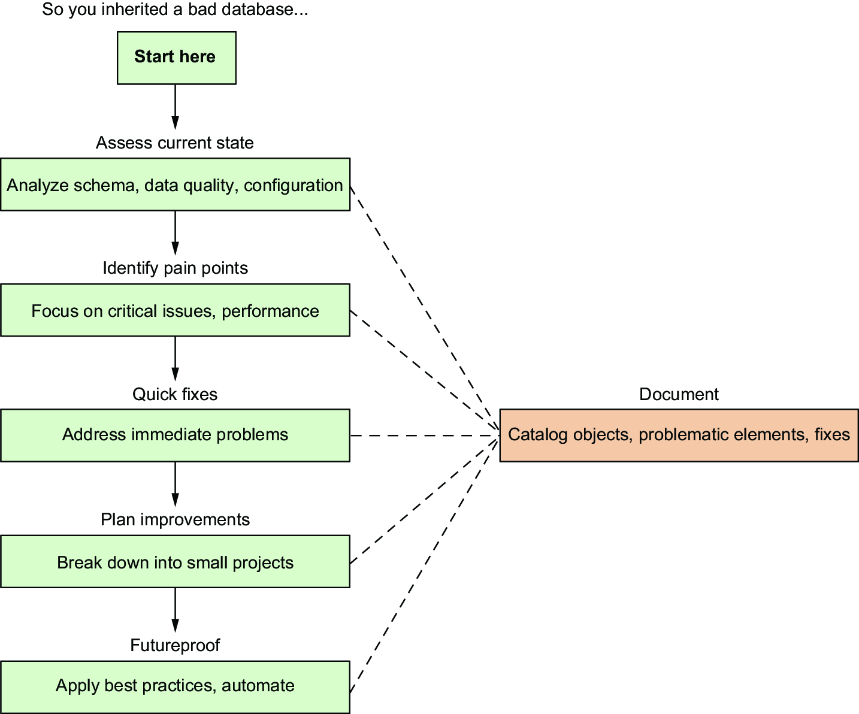
Use the roadmap to move from schema assessment through prioritized repairs, documentation, and future improvement. section 11.3.3











































