Security risk grows as a GenAI assistant gains access to customer data, customized behavior, and operational actions: each added capability opens attack paths and failure modes. section 4.1
ClaimAssist’s expanding capabilities illustrate how deployment risk changes:
- A general FAQ chatbot answers policy questions. section 4.1
- Customer-data access enables personalized answers; fine-tuning adapts the assistant’s language. section 4.1
- Record updates, callbacks, and request processing add operational actions; an agentic version could plan multi-step tasks and select tools. section 4.1
Figure 4.1 ClaimAssist v1 on the left is a simple policy chatbot. ClaimAssist v4 on the right can accept user uploaded images and change a claim status as “ready for adjuster review”.
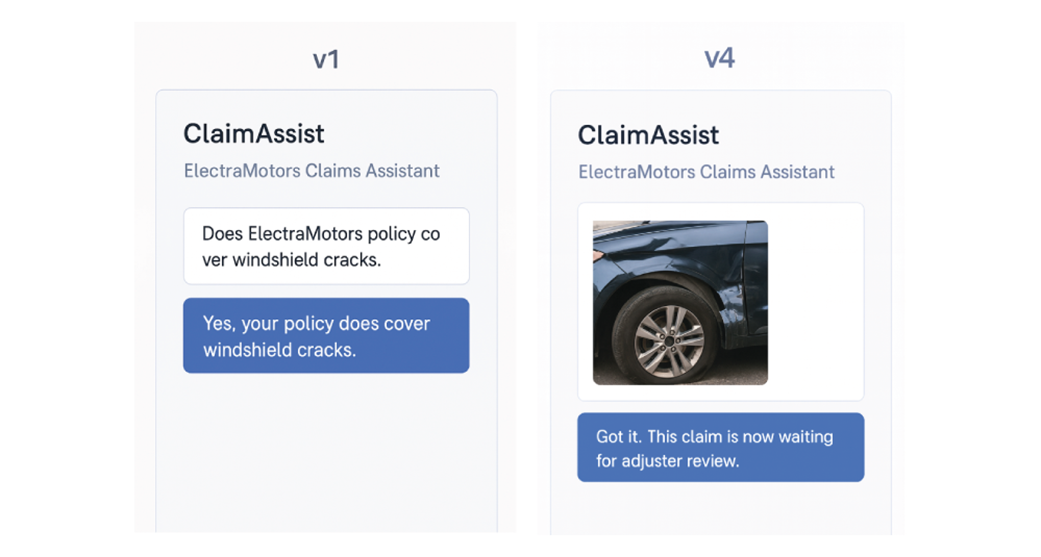
Compare ClaimAssist v1’s policy chatbot with v4, which accepts uploaded images and can change a claim status to “ready for adjuster review.” section 4.1