Sentiment analysis enriches text with an evaluative label. In a data pipeline, an LLM can classify article content as Positive, Neutral, or Negative, turning unstructured language into a field that downstream tools can store, aggregate, visualize, or model. section 5.0 section 5.4.1
Treat the model as a callable pipeline component, not a conversational endpoint. Send article content in a focused prompt, extract the response content, and return a value designed for the next step. Raw explanations may be useful for inspection, but verbose and inconsistent responses are poor inputs for dashboards, databases, and large-scale processing. section 5.3 section 5.3.2
A practical implementation pattern is:
- Fetch and preprocess article text into clean content blocks before classification. section 5.0
- Prompt for exactly one permitted label: Positive, Neutral, or Negative. section 5.4.1
- Extract and trim the API response content rather than retaining unrelated response metadata. section 5.3.2
- Loop over DataFrame content, append labels to a sentiment column, and log each processed record. section 5.4.2
- Validate outputs and expect ambiguity: sarcasm, mixed language, context, prompt wording, and model choice can change labels. section 5.3.2
News sentiment enrichment
Fetch live Tesla articles with NewsAPI, preprocess their content, call the OpenAI Chat Completions API for each article, and add a normalized sentiment label to a pandas DataFrame. Log progress so the resulting table is ready for PostgreSQL, Tableau, scikit-learn, or simple label counts. section 5.4.2 section 5.5
Figure 5.2 This diagram illustrates the full mental model for the use case. Articles are fetched from the NewsAPI using the requests library, then preprocessed into clean content blocks. The OpenAI API is embedded within the Python environment to analyze sentiment, returning structured labels. Finally, results are stored in a pandas DataFrame and logged—ready for downstream use in tools like scikit-learn, PostgreSQL, or Tableau.
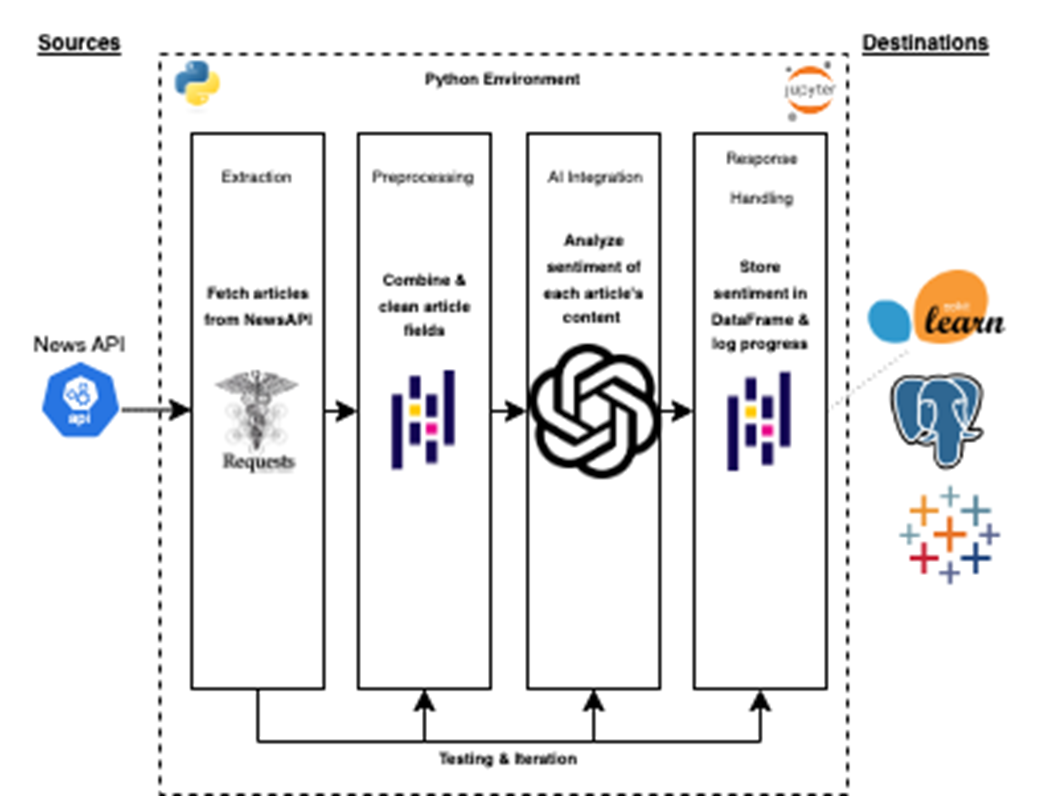
Follow the end-to-end path from NewsAPI articles through preprocessing and LLM labeling to a logged pandas DataFrame for downstream delivery. section 5.0
Once sentiment proves useful, operationalize it upstream rather than leaving it as an isolated analyst task. That makes the enriched feature broadly available while shifting attention to quality, performance, scale, and guardrails. section 8.1.1














