Supervised learning uses labeled examples—past situations paired with correct outcomes—to learn mappings from inputs to outputs. It can predict customer churn or transaction fraud and is evaluated on unseen cases. Unlike reinforcement learning, it predicts outcomes rather than learning how to act through rewards and penalties. section 1.1
Supervised fine-tuning teaches a language model what a high-quality response looks like using query-response pairs. Training examples combine prompts, user queries, ideal responses, and sometimes padding; training targets only the ideal-response tokens. section 10.5
Medical chatbot
A patient asks whether fatigue and dizziness could be caused by low iron. A labeled example pairs the query with a response that acknowledges the concern, notes possible causes, and recommends medical evaluation. section 10.5
Figure 1.1 Reinforcement learning in the context of machine learning.
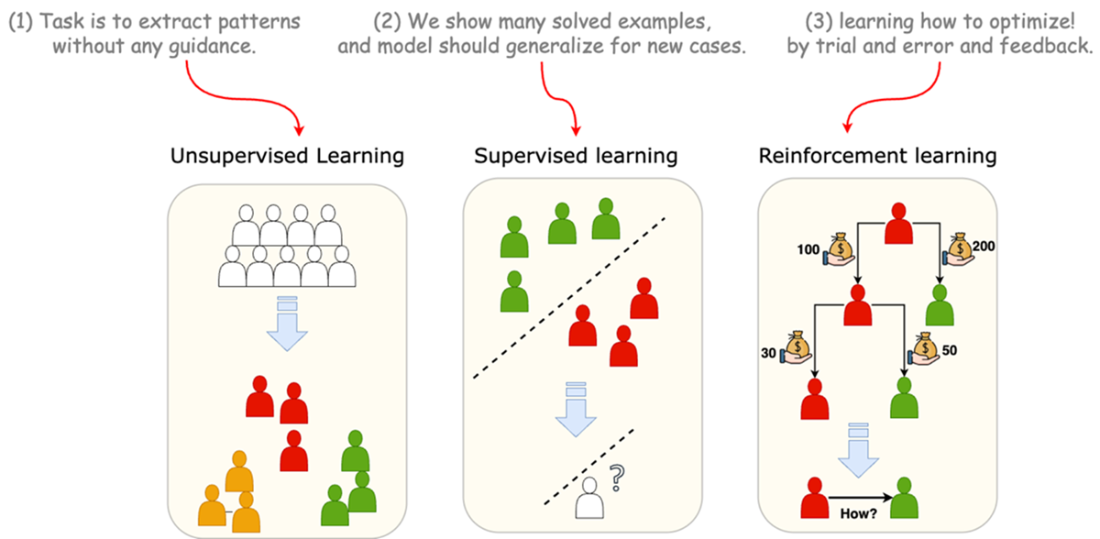
Compare supervised learning with unsupervised learning and reinforcement learning. section 1.1
Figure 10.4 Supervised Fine-Tuning with label masking.
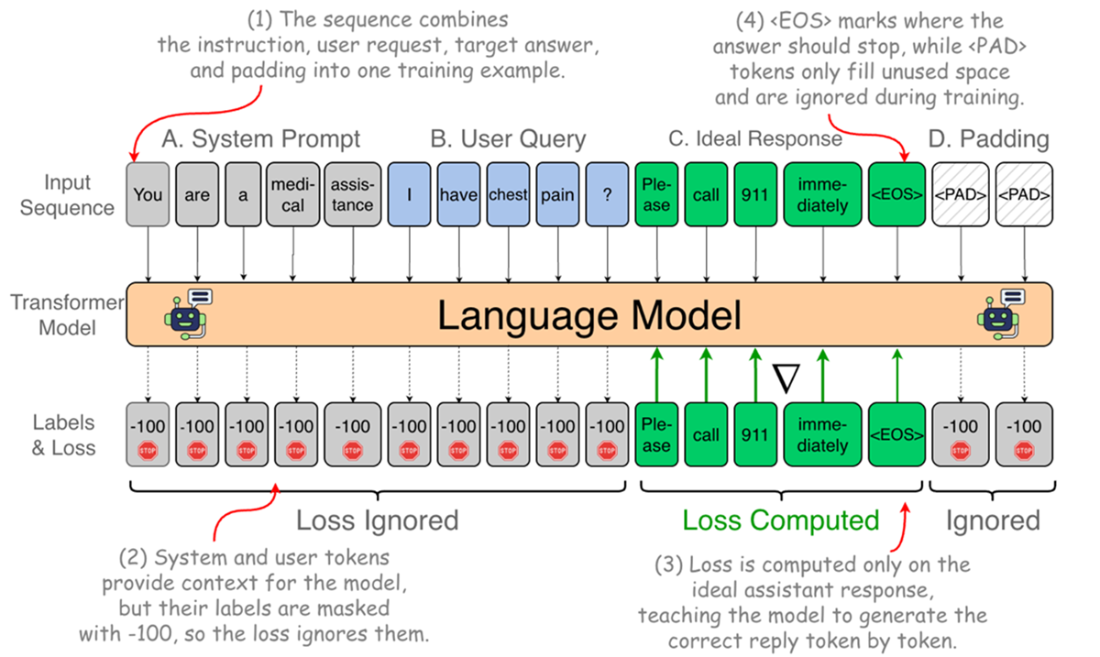
See how supervised fine-tuning formats examples and masks training labels. section 10.5























