GPU throughput measures how quickly work is completed: compute throughput is measured in floating-point operations per second, while memory bandwidth measures bytes transferred per second. A kernel’s arithmetic intensity helps show which resource limits its performance. section 3.1.3 section 3.1.5
The roofline model compares a kernel’s performance with compute and memory ceilings. Low arithmetic intensity points to a memory-bound kernel; high arithmetic intensity points to a compute-bound kernel. Distance from a ceiling indicates remaining optimization headroom. section 3.1.5
Figure 3.2 Visualisation of three kernels as Compute Bound, Memory Bound and Optimal through the roofline model
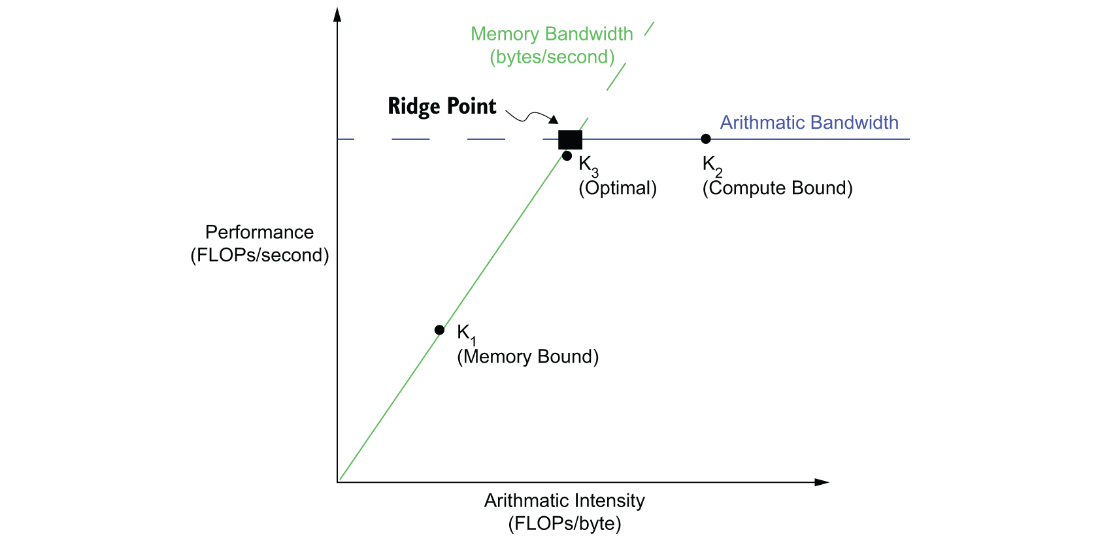
Compare the memory-bound, compute-bound, and near-optimal kernel positions against the two hardware ceilings. section 3.1.5
H100 arithmetic intensity
The cited H100 peak rates correspond to roughly 590 FLOPs per byte. A workload doing far fewer operations per byte may be limited by memory bandwidth rather than compute. section 3.1.3































