liveBook · Manning

Vanishing gradient problem

As explained in Grokking Machine Learning

A neural-network training problem in which gradients become extremely small as they are propagated through layers, slowing or preventing learning.

During backpropagation, gradients guide updates to a neural network’s weights. When sigmoid functions are composed across layers, their nearly flat regions can make derivatives—and therefore weight updates—extremely small. Learning may then take a very long time. section 10.2

Flat sigmoid, tiny updates

At large positive or negative inputs, the sigmoid curve is nearly flat. Its derivative is close to zero, so backpropagation can take tiny steps. ReLU is described as reducing this problem. section 10.2 section 10.6

Figure 10.17 The sigmoid function is flat at the ends, which means that for large positive and negative values, its derivative is very small, hampering the training.
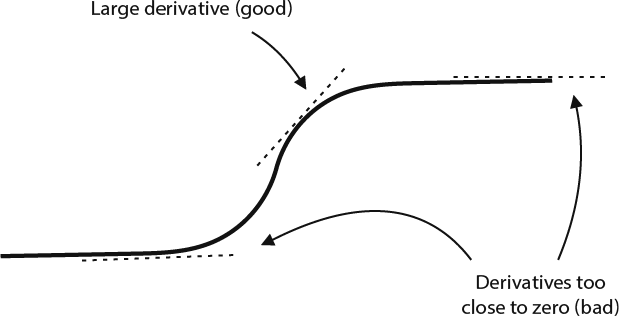
The sigmoid plot highlights the flat ends associated with small derivatives. section 10.2


How Grokking Machine Learning covers it

How deep it goes
Explains how sigmoid derivatives shrink through backpropagation and points to activation changes without deriving gradients.
Examples
Uses sigmoid’s flat ends and contrasts its training effect with ReLU’s reduction of the problem.
What you can do after
Understand why sigmoid activations can slow training and how ReLU can reduce the problem.
How it connects
Links neural networks and backpropagation to sigmoid, activation functions, and ReLU.

Also explained in

Compare how 14 books explain vanishing gradient problem →

Related concepts

This explainer was generated by Manning's knowledge graph from the text of Grokking Machine Learning. The section links point to the parts of the book it draws on.










