The vanishing gradient problem occurs when the gradient with respect to a network’s parameters becomes so small that weight updates make almost no progress. Formally, when ||∇ΘfΘ(x)|| approaches zero, learning effectively stops, even if the learning rate is large. section 6.1.1
Saturating activations are a common cause. For large positive inputs, tanh and sigmoid flatten near 1; for large negative inputs, they flatten near −1 and 0. Their derivatives consequently approach zero, so saturated neurons transmit little learning signal backward. section 6.1.1
Use these distinctions when diagnosing or reducing the problem:
- Distinguish vanishing gradients from exploding gradients: tiny gradients require excessive optimization steps, while huge gradients cause overly large updates. section 5.1.2
- Inspect gradient histograms when learning stalls; saturation is common but is not the only possible cause. section 6.1.1
- Try ReLU instead of tanh or sigmoid when saturation is not intentional; ReLU commonly converges more accurately in fewer epochs. section 6.1.2
- Use leaky ReLU when inactive ReLU units are costly: its negative side retains a small slope controlled by α. section 6.1.2
Activation derivatives as a quick check
For tanh, use tanh′(x) = 1 − tanh(x)²; for sigmoid, use σ′(x) = σ(x)(1 − σ(x)). Plot these derivatives over an input range such as −5 to 5: values near zero identify saturated regions. ReLU instead has derivative 1 for positive inputs and 0 for nonpositive inputs; leaky ReLU replaces the zero branch with α.
Figure 5.2 A toy example showing three scenarios for gradient descent. Each is a contour plot of a 2D optimization going from red (high values, bad) to dark green (low values, good). The ideal case is at the top left, where each gradient heads exactly toward the solution. The top right shows noisy gradients that cause the descent to head in not quite the correct direction, requiring more steps. The bottom left shows exploding gradients, where we begin to take steps that are far too large and head away from the solution. The bottom right shows vanishing gradients, where the gradient becomes so small that we have to take an excessive number of steps to get to the solution.
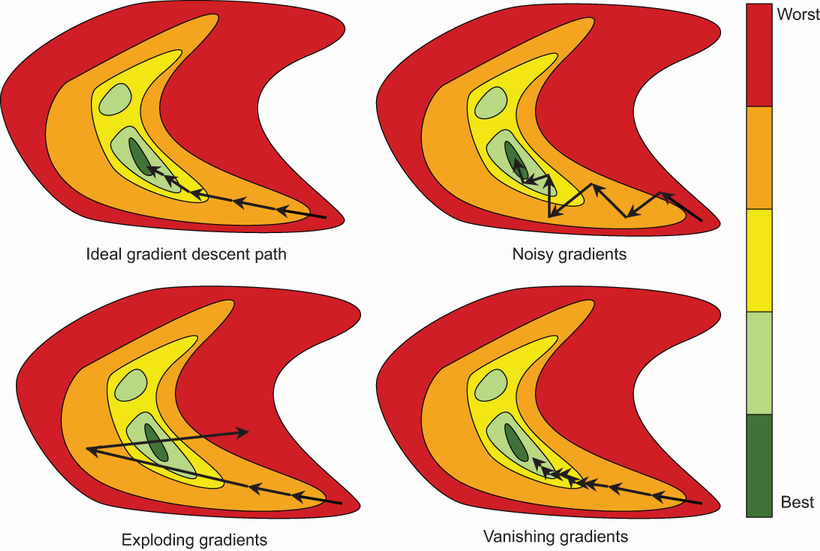
Compare ideal, noisy, exploding, and vanishing optimization paths in a contour plot; the vanishing case requires excessive steps because each gradient is too small. section 5.1.2













