The vanishing gradient problem makes deep-network training ineffective when gradients propagated toward early layers become nearly zero. With backpropagation, the chain rule multiplies derivatives from later layers backward; repeatedly multiplying small values produces an increasingly smaller gradient. Sigmoid units are especially vulnerable when their preactivation is very high or low, because their derivatives become small. section 11.2.1
ReLU addresses this difficulty with ReLU(x) = max(0, x). Its derivative is 1 for positive inputs and 0 elsewhere, so positive activations do not introduce the small sigmoid derivative that causes vanishing gradients. ReLU therefore supports faster convergence in deep networks and appears throughout VGG-style convolutional blocks. section 11.2.1 section 11.5
Deep convolutional architectures
A deep VGG network stacks convolutional blocks and ReLU layers, avoiding sigmoid-based gradient shrinkage. GoogLeNet addresses the same depth-related risk differently by adding two auxiliary classifiers: intermediate losses provide training signals so the middle of the network does not “die out.” section 11.2.1 section 11.2.2
Figure 11.6 Graph of a 1D sigmoid function (dotted curve) and its derivative (solid curve)
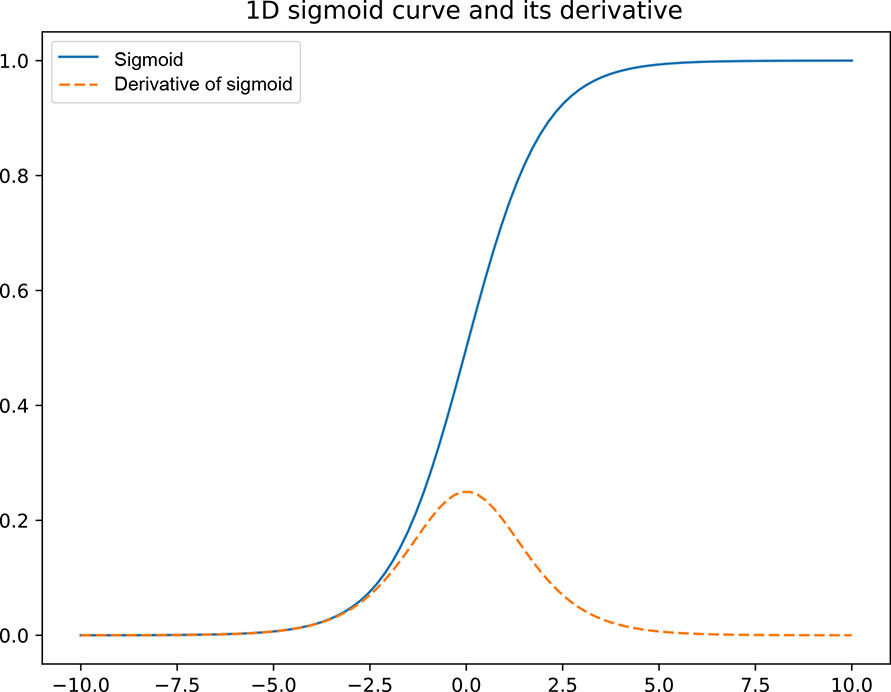
Compare the sigmoid curve with its derivative to see why saturated sigmoid units transmit only small gradients. section 11.2.1













