An embedding is a vector representation produced from an input such as an image, word, sentence, or graph node. Learned embeddings encode useful properties or relationships so that related inputs occupy similar positions in an embedding space. section 7.2.2 section 9.3.1
A fraud-oriented face-matching workflow uses embeddings as follows:
- Run a face image through a CNN such as Inception Resnet V1 to produce an embedding. section 7.2.2 section 7.2.4
- Compare selfie and identity-document embeddings with cosine similarity. section 7.2.4
- Train a Siamese network on same-person and different-person image pairs, using binary cross-entropy to improve the embeddings. section 7.2.2
Embedding meaning depends on the input structure. Image embeddings summarize one image independently; text embeddings incorporate preceding-word context; node embeddings also incorporate a graph node’s neighborhood. section 9.3.1 section 5.2.1
Selfie-to-ID fraud check
An Einstein selfie compared with his genuine ID produces a 61.54% similarity score, while Monroe’s ID produces 2.52%. A fake ID reusing Einstein’s selfie produces 100%, an abnormally high result that signals image reuse rather than identity confidence. section 7.2.4
Figure 7.12 Demonstration of how a face recognition model is trained using the Siamese network. Two copies of a CNN model produce two different embeddings for two different faces (images). These embeddings produce a cosine similarity score. This score is passed through a sigmoid function and compared to the label (1 if faces are from same person and vice versa) using a loss function such as binary cross entropy.
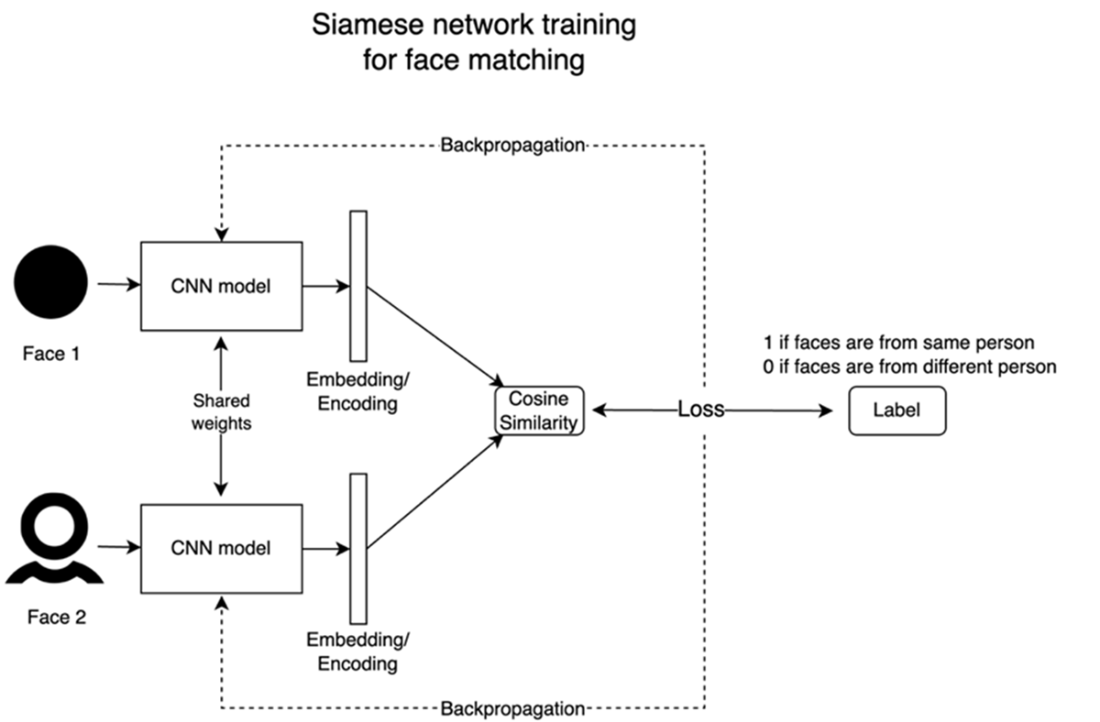
Trace the Siamese-network pipeline from two face images through replicated CNNs, embeddings, cosine similarity, sigmoid scoring, and binary cross-entropy. section 7.2.2







































































