An embedding represents data as a numerical vector whose geometric relationships encode semantic similarity. In retrieval systems, source chunks and user queries become vectors so related material can be found without scanning the entire context window. section 3.5.1
A practical embedding-based retrieval workflow follows these stages:
- Index source files, documentation, and configuration by splitting them into meaningful chunks such as functions, classes, or markdown sections. section 3.5.1
- Convert each chunk into an embedding and store the vectors in a specialized vector database. section 3.5.1
- Convert a developer query into a vector, perform similarity search, and retrieve the most relevant chunks. section 3.5.1
- Augment the prompt with the retrieved chunks so the model responds from a curated slice rather than an overloaded context window. section 3.5.1
Repository-aware authentication help
For a request to fix authentication, retrieval can surface the auth.js login handler and related tests. For a JWT refactor, it can locate semantically relevant code and documentation before generation. section 3.5.1
Figure 3.7 Context-aware assistance flow. The developer's query is converted into an embedding, matched against the indexed codebase, and the most relevant chunks are injected into the prompt before the model generates its response.
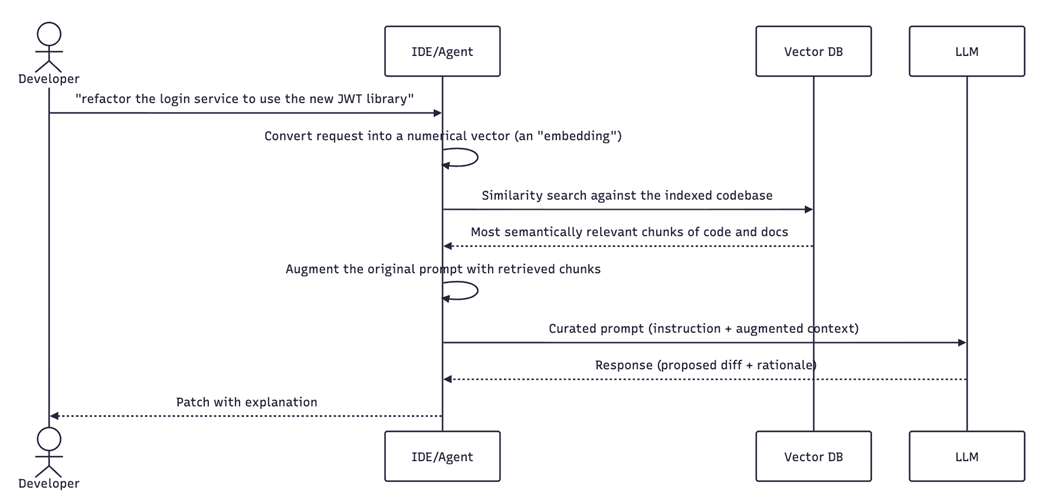
Trace the flow from a developer query to its embedding, matched repository chunks, augmented prompt, and generated response. section 3.5.1







































































