An embedding represents a complex entity, such as a user or a piece of content, as a list of numbers. These numbers preserve information useful for comparing users with items and ranking recommendations. section 2.7
Ranking by closeness
With one number per user and item, a user represented by 0.8 would see items represented by 0.9, 0.2, and −0.6 ranked in that order. A cat-and-dog example extends this idea to two numbers: one for affinity to each animal. section 2.7
Figure 2.12 Two-dimensional representation of users’ and items' embeddings. We represent users and items as two numbers: one for cat affinity and one for dog affinity. Such numbers can also be used as coordinates to represent them on the plane. User A has a high affinity for both animals, so they are in the top-right corner, while user B is neutral and close to the center. The items recommended for them are those that minimize the distance to their respective embeddings.
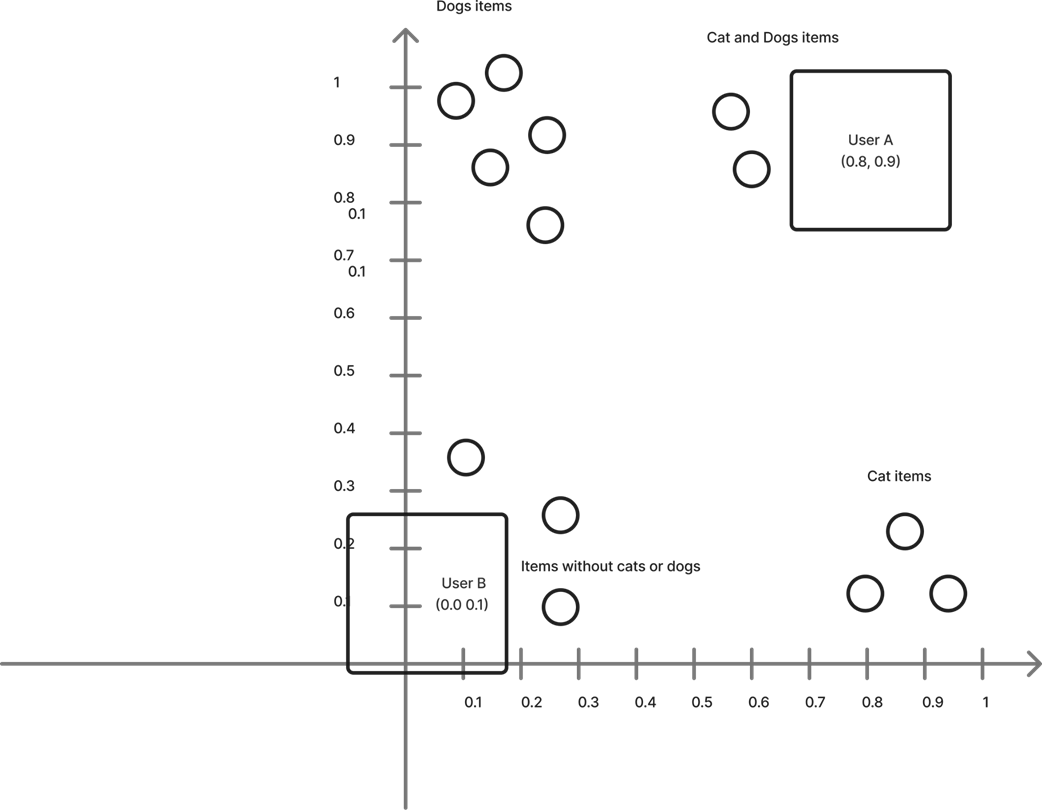
See how cat and dog affinities place users and items as points on a plane, with nearby items recommended. section 2.7