An application programming interface (API) is a defined way for software to request data or functionality from other software. Its contract tells a calling application what it can access and what inputs to provide. It is for software-to-software communication, not a graphical interface for people. section 8.1 section 8.6
An endpoint is one place to make a request. It is often a unique HTTP URL: send arguments to that address and receive a result. An API can collect multiple endpoints so another application has a managed way to use them. section 8.1 section 8.6
Figure 8.2 An API has endpoints, which are often HTTP URLs that can be accessed over the Internet.
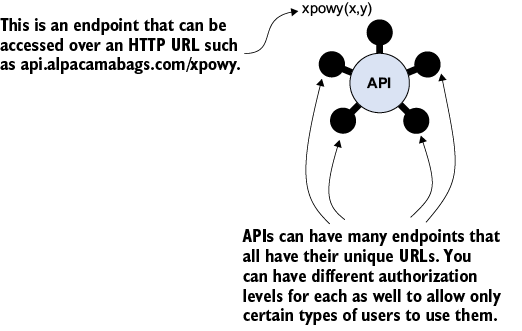
The figure shows how an API endpoint gives callers a network address for a request. section 8.1
A shop shares NFT images
A web shop stores a reference and image when an NFT is created. A public-facing API can make those images accessible to partners who have been granted access. The partner connects through the API instead of needing the shop’s own interface. section 8.1
A contract can also reflect a familiar way of working with data. Azure Cosmos DB offers APIs for different data models: its MongoDB API lets an existing MongoDB application use its queries and drivers, while its Table API supports applications built for Azure Table Storage. Choose the interface that fits the application rather than treating every API as interchangeable. section 11.2.1











































