Accountability makes authorization actions and decisions traceable to responsible parties, applicable policies, and organizational intent. When an access decision is challenged, evidence should show the policies in effect, the data used, the context available, and the resulting decision. section 17.3.4 section 17.5
An accountable authorization system:
- Records outcomes in decision logs, including evaluated policies, available context, conditions, and allow-or-deny results. section 17.5
- Uses AI to summarize decisions, surface unusual patterns, cluster similar outcomes, and identify cases for human review. section 17.5
- Keeps enforcement deterministic: AI explains and analyzes decisions afterward rather than deciding whether access is permitted. section 17.3.4 section 17.5
- Links each decision to a policy, each policy to an owner, and each owner to recorded business intent. section 17.5
Figure 17.5 Runtime analysis and governance loop. Authorization outcomes captured in decision logs are analyzed with AI assistance and surfaced as questions, patterns, and reports. These insights feed into governance processes, where humans interpret the evidence and decide whether policy changes are needed. The flow makes authorization behavior observable and actionable without placing AI in the enforcement path.
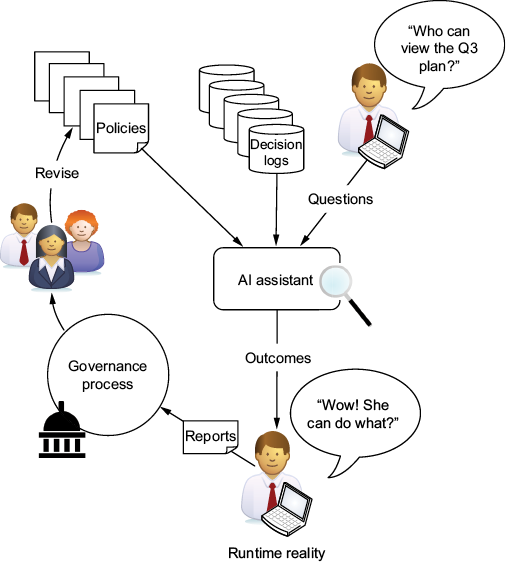
The runtime analysis and governance loop shows how authorization outcomes become evidence, how AI surfaces patterns and questions, and how humans decide whether policies need changing. section 17.5
Challenged access decision
A team investigating a disputed denial can inspect the decision log, identify the policies and data used, review the governing policy owner, and determine whether the observed behavior matches organizational intent. section 17.3.4 section 17.7











