Accountability means taking responsibility for decisions, work, and results, then using failures to improve the process rather than assign blame. In code review, it belongs to both the individual author and the team that maintains the codebase. section 2.4.1 section 1.5
A practical accountability loop for review teams:
- Run appropriate tests before review so predictable problems are caught before another person spends review time on them. section 2.4.1
- When something goes wrong, discuss what happened collectively and individually, then make a concrete process change. section 2.4.1
- Keep human review focused on problems requiring judgment, while automating syntax, compilation, unit tests, and recurring functional scenarios. section 2.4.1
- Create accountability collectively by agreeing on review goals, standards, constraints, and the systems the team can sustain. section 1.5
From recurring failures to shared ownership
A team identified five browser scenarios that repeatedly needed attention, trained its QA tester on Selenium, and set automation as a shared goal. Reaching an ideal test-coverage state took four sprints; automating most manual scenarios took six. The accountability lesson was not to blame one person, but to automate appropriate checks and improve the process together. section 2.4.1
Figure 2.8 An example of clear and constructive feedback
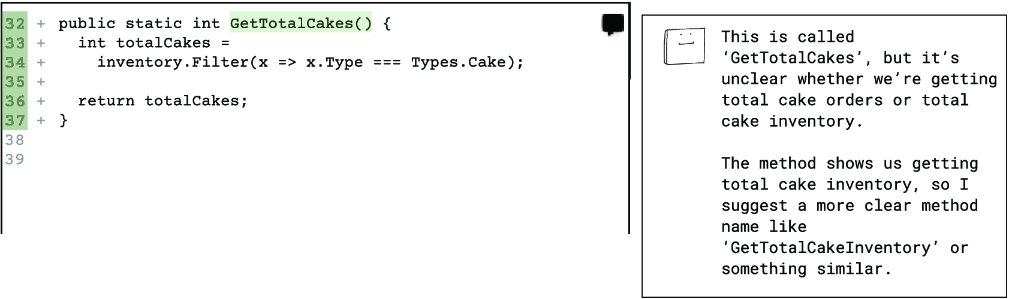
Use clear, constructive review feedback to make responsibility actionable without turning review into blame. section 2.4.1











