Accountability assigns responsibility and answerability for AI decisions, especially when recommendations fail or affect people. It combines human oversight with records that make decisions traceable. section 11.4 section 11.4.3
Figure 11.8 The three components of transparency are explainability, interpretability, and accountability.
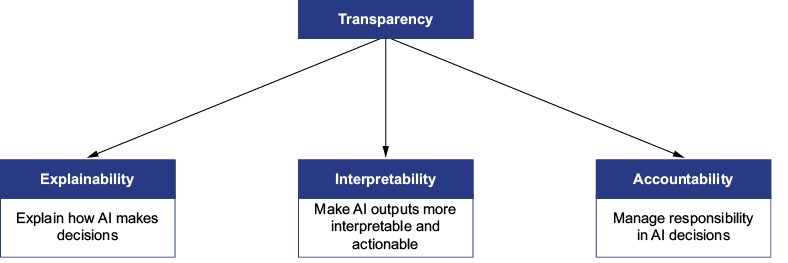
Positions accountability alongside explainability and interpretability as a component of AI transparency. section 11.4
Match oversight to the risk, impact, confidence, and speed of the AI decision:
- Human-in-the-loop requires a person to review, approve, or modify the outcome before execution; use it for high-risk decisions such as hiring or investment recommendations. section 11.4.3
- Human-on-the-loop allows autonomous decisions while people monitor activity and intervene when necessary; use it for rapid processes such as fraud detection or content moderation. section 11.4.3
- Human-out-of-the-loop permits independent operation under predefined rules or models for low-risk, high-frequency work such as dynamic pricing. section 11.4.3
Recommendation failure
A recommendation engine suggests cutting marketing budgets for a high-performing product without a clear rationale. Assigned oversight, user intervention, and decision logs provide a path to review the error and restore trust. section 11.4 section 11.4.3











