A model can make different mistakes at different classification thresholds. The area under the curve (AUC) compresses that across-threshold performance into one number, using a receiver operating characteristic (ROC) curve or, especially with imbalanced data, a precision-recall curve (PRC). section 8.10 section 8.11
Read the curves as threshold tradeoffs:
- The ROC curve compares the true positive rate with the false-positive rate across thresholds. section 8.10
- Each threshold creates a different confusion matrix, changing the balance between missed positives and false alarms. section 8.10
- AUC provides a single summary instead of requiring inspection of hundreds or thousands of threshold-specific confusion matrices. section 8.10
- Use a precision-recall curve when the classes are imbalanced; accuracy alone can then mislead. section 8.11
A toddler-meltdown classifier
A logistic regression predicts whether a toddler will have a meltdown from hours without a nap. Rather than choosing one threshold immediately, evaluate the model on a larger test dataset across thresholds and report its ROC curve and AUC. The same workflow can show a precision-recall curve when false alarms and missed meltdowns need a different balance. section 8.10
Figure 8.8 The receiver operating characteristic (ROC) curve for my logistic regression toddler meltdown prediction, across different thresholds
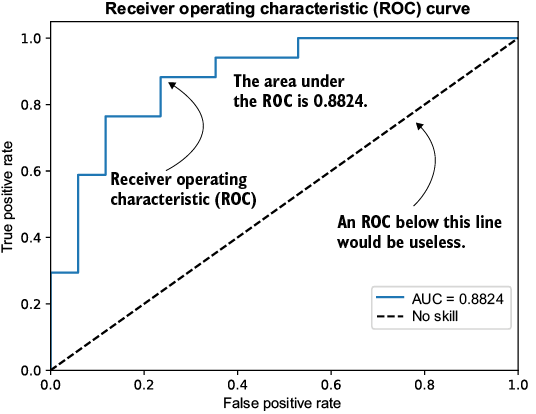
Inspect how the ROC curve changes as the classifier threshold moves, then read its AUC as a compact performance summary. section 8.10











