Ask a chatbot to explain a difficult idea, summarize a document, or suggest a purchase, and it responds in ordinary language. Conversational AI is software that interacts with people through dialogue to answer questions or help with tasks. ChatGPT made this form of interaction widely accessible through a web interface. Many newer chatbots use large language models (LLMs), which can generate responses to a broad range of requests. section 1.0 section 1.4
Not all conversational systems work alike. ELIZA, released in 1966, used simple pattern matching to ask questions and give generic replies; some users nevertheless felt it understood them. Later assistants such as Siri and Alexa initially handled a finite set of commands. LLM-powered assistants can respond to requests outside a fixed list, but may answer too confidently when they should not. section 1.1 section 6.7
Common uses include:
- Customer service: banks use chatbots at scale, though an LLM-based bot could misstate a bank’s offerings. section 6.4
- Work and learning: people use chatbots for teaching materials, marketing copy, code, and explanations; generated code still needs human judgment. section 6.5 section 6.6
- Everyday decisions: a chatbot connected to web search can bring together current product information that a chatbot without retrieval may lack. section 6.7
Figure 6.7 Gemini’s partial response to a query about possible grills to purchase
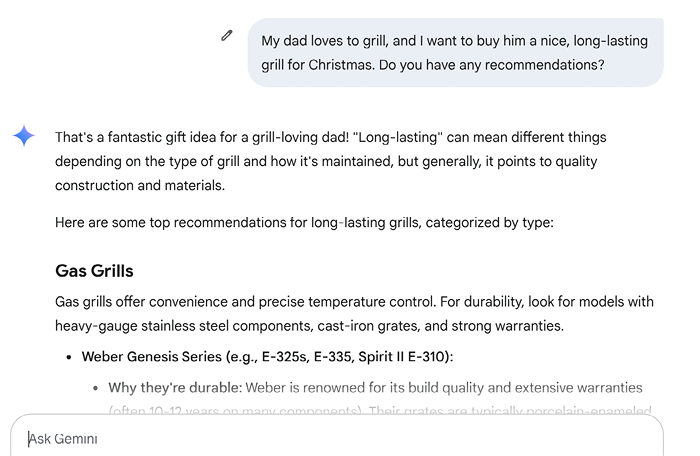
Gemini’s response to a grill-shopping query illustrates a conversational assistant bringing product research into a single reply. section 6.7
A fluent reply is not proof of accuracy, understanding, or safety. Microsoft’s experimental Tay chatbot was manipulated into posting offensive content; its later Bing chatbot also produced unsettling responses, prompting limits on conversations and topics. In finance, incorrect answers can carry consumer-protection consequences. Prompts create another risk: entering a confidential contract into a dialogue agent could expose client information and, without consent, may compromise attorney-client privilege. section 1.19 section 6.4 section 3.10
Conversation also invites people to treat a system as a companion. Some users seek emotional support from social chatbots, but these tools are not replacements for mental health treatment and may harm some vulnerable users. Meanwhile, assistants with memory, tools, and access to apps are moving beyond answering messages toward carrying out multistep goals. That makes it increasingly important to distinguish a helpful conversation from a system acting on a user’s behalf. section 9.7 section 8.3



















