Conversational AI lets software respond to people in natural language. Its dialog engine, or chatbot, takes a statement, works out what the person may want, and produces a reply. A voice assistant adds speech input and output around that process; a human-sounding voice is not, by itself, evidence that the system understands the conversation. section 1.2.2 section 12.7.4
A useful chatbot does more than recognize isolated words. It must track conversation state, recognize user intent, and choose text that helps the user reach a goal. Those goals matter: a customer-service bot that delays access to a person may serve its operator while failing its user. section 12.9 section 12.0
Start with a greeting rule
A minimal Python bot can split a message into words and check its first word: `greetings = "Hi Hello Greetings".split(); words = "Hello Joshua".split(); reply = "Hello!" if words[0] in greetings else "I don't recognize that greeting."` This illustrates an intent recognizer with two outcomes: greeting and unknown. It also shows the weakness of a hand-written rule: another phrasing needs another rule or a more flexible recognizer. section 1.5.1 section 1.5
Response strategies can be combined rather than treated as rival definitions of a chatbot:
- Rules and regular expressions match recognizable phrases, extract information, and trigger scripted responses. They offer control but require someone to anticipate ways users will speak. section 1.4.2 section 1.5
- Search retrieves a relevant response from stored text or past conversations. Exact-string lookup is brittle: a typo or new phrasing can defeat it even when the meaning is familiar. section 1.12 section 1.5.3
- Language models can generate candidate replies; templates and search are other ways to generate them. A separate decision step can select a response suited to the conversational goal. section 1.8
Figure 1.7 Chatbot recirculating (recurrent) pipeline
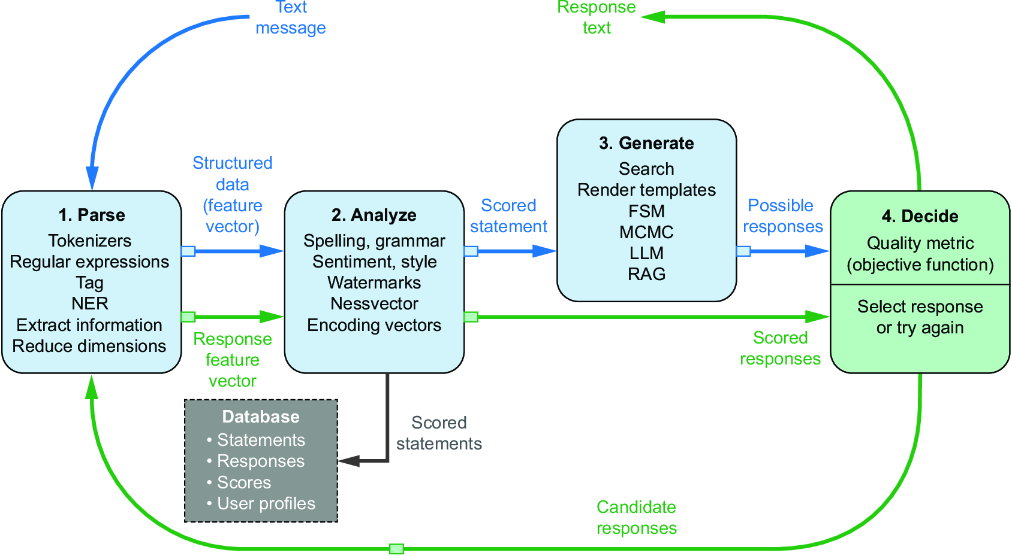
The recirculating pipeline places a reply inside an ongoing exchange. Parsing extracts features; analysis scores them; generation proposes responses; decision selects one; and a database retains conversation history, user information, and knowledge. section 1.8
The same tools can support a virtual assistant, a team-operations bot, a healthcare information service, or a customer-service interface. The application determines what the bot needs to know and what a successful conversation looks like. Speech-to-text and text-to-speech can add a voice, but the dialog engine still needs to handle the words between them. section 12.1 section 12.7.4
Do not mistake fluent output for reliable cooperation. Rule-based approaches remain useful when behavior must be controlled; a language model alone is neither fully explainable nor controllable. Design around users’ likely needs, maintain context, and evaluate replies by whether they help people achieve their goals. section 12.9



















