Accuracy is the proportion of predictions that match observed outcomes. It answers how well a model predicts, not whether an action changes what happens. section 3.3.1
A perfectly accurate recommendation
Suppose a customer buys bread every Monday, Wednesday, and Friday. A recommender can predict the next purchase with 100% accuracy, yet the customer would buy bread without seeing the recommendation. The prediction is accurate, while the recommender’s causal effect on buying is zero. section 3.3.1
Interpret accuracy according to the question being asked:
- Use predictive accuracy to assess how well a model forecasts outcomes on new data. section 5.3.2
- Do not treat high accuracy as evidence that a recommendation or treatment caused the outcome; compare treated and untreated groups when causal efficacy matters. section 3.3.1
- For propensity scores, prefer AUC to accuracy because perfect treatment prediction can violate the positivity assumption; lower AUC may be better. section 5.3.2
Figure 3.12 Graph of a pure recommender system that does not influence the customer. This system may predict customer behavior accurately, but it does not affect their actions.
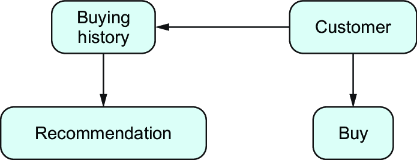
Use the causal graph to separate accurate prediction from an arrow representing influence on customer behavior. section 3.3.1































