Accuracy concerns correctness, but its meaning depends on what is being assessed. As a data-quality attribute, it asks whether recorded data are correct; inaccurate data can lead to faulty insights and actions. section 1.2.3
A practical check is to define key performance indicators (KPIs) and compare them with figures reported by the business. This helps assess whether the available data are authentic before analysis. section 1.2.3
For clustering, accuracy is assessed through cluster compactness and separation rather than simply maximizing the number of clusters. WCSS measures spread around a cluster centroid; lower values indicate more compact clusters. Intercluster distance compares cluster centroids, with larger values indicating more distinguishable clusters. The silhouette value ranges from −1 to +1, and higher is better. section 2.3.2
Figure 2.9 Intracluster vs. intercluster distance. Both are used to measure the purity of the final clusters and the performance of the clustering solution.
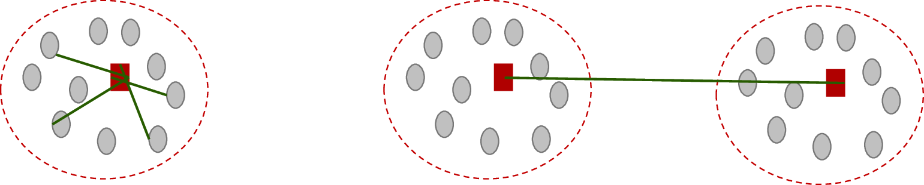
Compare intracluster spread with the distances between cluster centroids when judging clustering quality. section 2.3.2































