Accuracy is the share of predictions that match the evaluation criterion. If a model gets 48 of 50 cases right, its accuracy reflects those 48 successful predictions. section 4.1.1
Accuracy is useful for judging predictive success, but it is not smooth: one prediction changes the score in a jump, and partial correct cases do not exist. Because training algorithms need a better-behaved target, cross-entropy loss often acts as a proxy for accuracy. section 4.1.1
A cancer-prediction example
For 50 patients, a model that predicts 48 correctly has 48 successful predictions out of 50. The result cannot become 48.2 correct cases, so accuracy changes discretely rather than continuously. section 4.1.1
Figure 4.2 Examples of a smooth function on the left and two nonsmooth functions on the right. The center example is mostly smooth, but one region is not smooth because the function has no value. On the right, the function is not smooth anywhere due to the hard change in value.
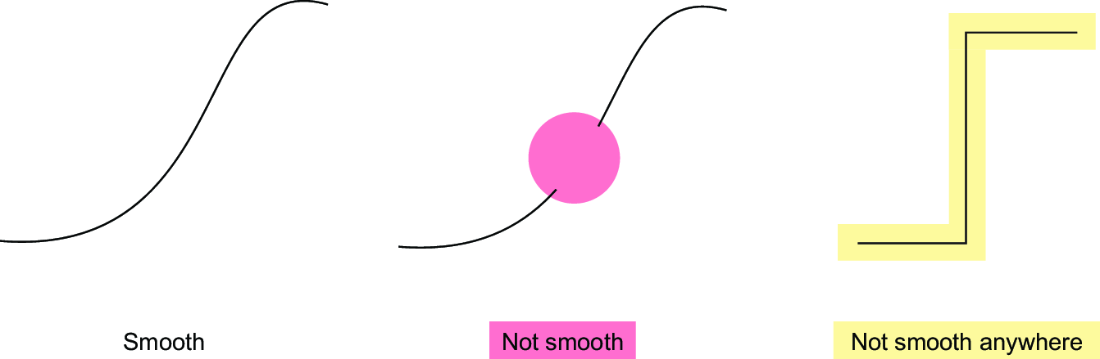
Use the figure to compare smooth functions with abrupt, nonsmooth changes—the behavior that makes accuracy unsuitable as a direct training loss. section 4.1.1































