liveBook · Manning

Clustering

As explained in Optimization Algorithms: AI techniques for design, planning, and control problems

The task of partitioning objects into groups whose members are more similar to one another than to members of other groups.

Clustering groups objects into k nonempty sets so members within a set share a natural relation, measured through similarity or dissimilarity. Because group order does not matter, clustering is a combinatorial partitioning problem. section 2.1.1

Smart carts

Shopping or luggage carts left in different places could gather near designated assembly points, making collection and redistribution easier. section 2.1.1

Figure 2.3 Smart cart clustering. Unused shopping or luggage carts congregate near designated assembly points to make collection and redistribution easier.
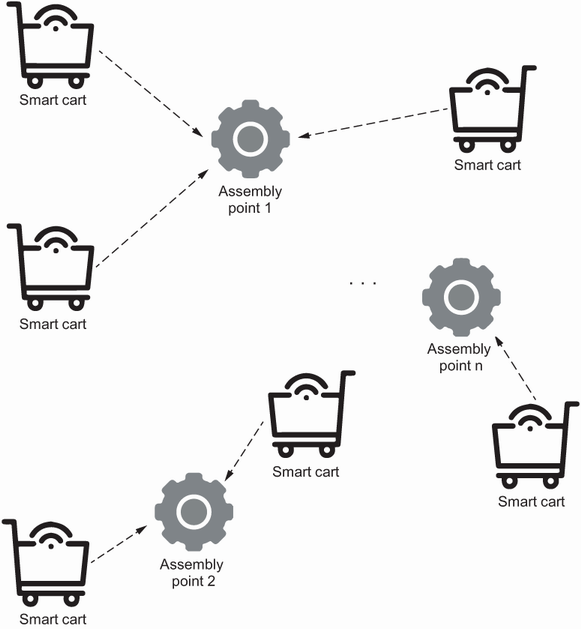
The figure illustrates carts congregating near designated assembly points. section 2.1.1


How Optimization Algorithms: AI techniques for design, planning, and control problems covers it

How deep it goes
Defines unordered grouping and relates partition counts to Stirling numbers, without detailing a clustering algorithm.
Examples
Uses smart shopping or luggage carts gathering near designated assembly points as a practical example.
What you can do after
Understand clustering as grouping objects into unordered sets according to similarity or dissimilarity.
How it connects
Connects clustering to combinatorial problems, set partitions, and similarity or dissimilarity metrics.

Also explained in

Compare how 18 books explain clustering →

Related concepts

This explainer was generated by Manning's knowledge graph from the text of Optimization Algorithms: AI techniques for design, planning, and control problems. The section links point to the parts of the book it draws on.















